
Spring 2024 Cohort
Advancing Global Health Justice
Led by Alicia Ely Yamin, Lecturer on Law at Harvard Law School and Director of the Global Health and Rights Project at the Petrie-Flom Center, this Scholarly Working Group brings together faculty across Harvard to examine the legal, political, and economic structures that shape global health and health equity. The group focuses on questions of power and accountability in global health governance, including how international institutions, financing structures, and legal frameworks can either advance or undermine health justice.
The working group brings an interdisciplinary perspective to global health governance, drawing on expertise in law, public health, medicine, and political economy. Its work seeks to develop new frameworks for understanding power in global health and to build connections among researchers, policymakers, advocates, and communities working toward a more equitable global health system.
The Work
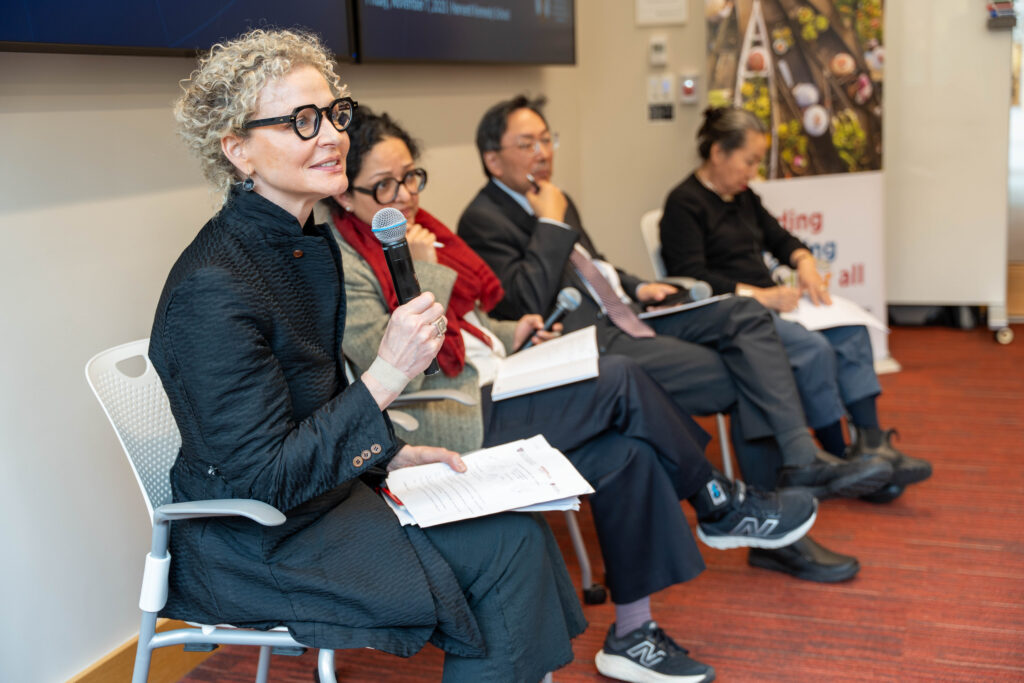
As part of the Scholarly Working Group Initiative, Yamin convened a conversation in February 2024 with investigative journalist Tim Schwab on the influence of philanthropy and concentrated wealth in global health. The event, Power and Money in Global Health: A Conversation with Tim Schwab, examined questions of accountability, political influence, intellectual property, and the role of private philanthropy in shaping global health priorities.
The Advancing Global Health Justice Scholarly Working Group was then later renewed for a second year at the end of 2025. The group produced research, convened interdisciplinary discussions, and developed connections with communities of practice around global health governance and accountability.
One major output was a co-authored working paper, Global Health Governance and the Challenge of Holding Power to Account, which presents a conceptual framework for understanding power and accountability in global health governance.
The group also supported an international workshop on the role of the pharmaceutical industry in mental health policy and care, with a focus on middle-income countries. The workshop examined the influence of pharmaceutical industries on global mental health, including the under-studied phenomenon of the “psychiatrization” of mental health and the ways that commercial and institutional interests can shape how mental health needs are understood and addressed. The workshop contributed to a special issue of the Harvard Health and Human Rights Journal published in December 2025.
The working group also conducted an assessment of Harvard University’s offerings in global health governance and financing. The final report was presented to the HGHI Steering Committee and subsequently informed deliberations around the redesign of the Global Health and Health Policy undergraduate concentration.
New Multilateralism for Global Health Equity
Building on the group’s work on power, accountability, and global health governance, the Global Health and Rights Project launched a multidisciplinary project on A New Multilateralism for Global Health Equity – Petrie-Flom Center in 2025, in collaboration with the Graduate School of International Affairs at The New School.
The project brings together scholars and advocates from different disciplines and geographic regions to explore alternative approaches to multilateralism that address structural inequities in global health governance while responding to changing political and economic realities. An April 2025 meeting brought together 17 participants to develop principles and strategies for a more democratic and equitable global health architecture. The resulting 10 principles were published in Global Policy and the project will continue through 2026 through research, events, webinars, podcasts, and a forthcoming special issue.
Featured & Related Research
The Scholarly Working Group’s research and publications are featured on the Global Health and Rights Project page, including work on global health governance, health justice, and the political economy of global health.
Additional Working Group Members
Mary Bassett, Harvard T.H. Chan School of Public Health
Joia Mukherjee, Harvard Medical School
Eugene Richardson, Harvard Medical School
Jesse Bump, Harvard T.H. Chan School of Public Health
Climate Change and Health Collaborative
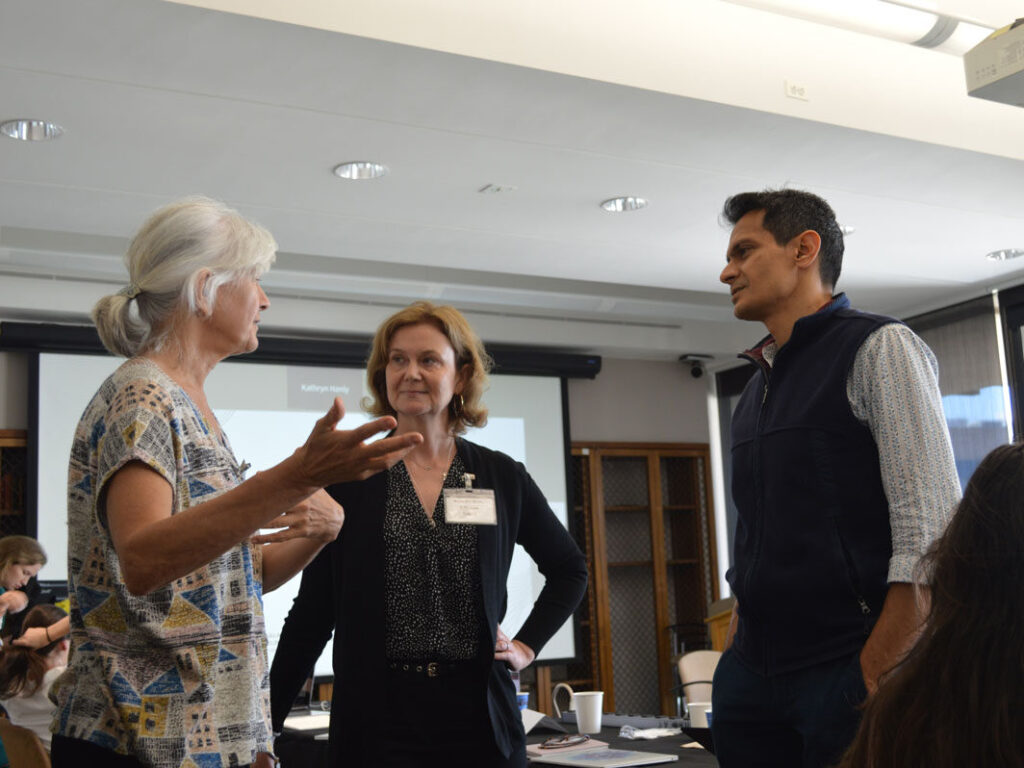
Led by Megan Murray, Ronda Stryker and William Johnston Professor of Global Health and Director of Research, Global Health and Social Medicine, Harvard Medical School, the Climate Change and Health Collaborative Scholarly Working Group worked to build a cross-disciplinary network that addresses the health impacts of climate change in low- and middle-income countries (LMICs). This group leveraged existing collaborations between Harvard faculty, global health organizations, and NGO representatives, to explore practical interventions that can mitigate the effects of extreme weather events and climate-related health crises. This group held a full day workshop with 40 climate and health experts, researchers and community advocates from 14 countries and regions to discuss the health impacts of climate change intensification.
Working Group Members
Bethany Hedt-Gauthier, Harvard Medical School
Vikram Patel, Harvard Medical School
Matt Bonds, Harvard Medical School
Ann Miller, Harvard Medical School
Lucas Trout, Harvard Medical School
Annikki Herranen-Tabibi, Harvard Medical School
Satchit Balsari, Harvard T.H. Chan School of Public Health
Caroline Buckee, Harvard T.H. Chan School of Public Health
Peter Huybers, Faculty of Arts and Sciences
Read more about their work
Tackling the Climate Crisis: Local Solutions for a Global Problem
Cholera: State of the Science
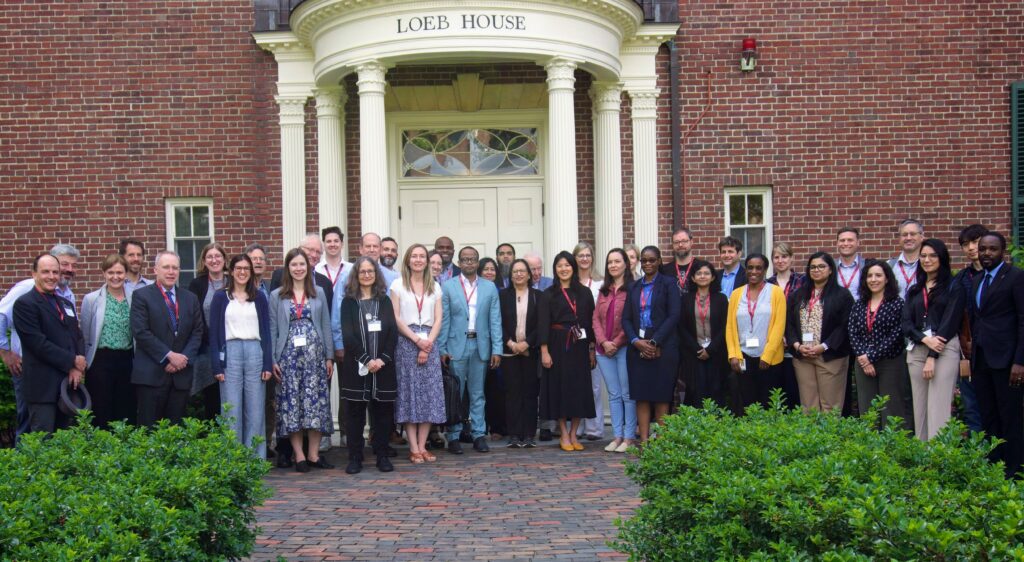
Co-led by Louise Ivers, Faculty Director at the Harvard Global Health Institute and Executive Director of the Center for Global Health at Massachusetts General Hospital, and Jason Harris, Professor of Pediatrics at Harvard Medical School and Associate Chief for Academic Faculty Affairs and Development in the MGH Department of Pediatrics, the Cholera: State of the Science Working Group convened a symposium at Harvard in 2024, bringing together over 50 leading experts from 20 organizations based in the Democratic Republic of the Congo, Haiti, Zambia, Bangladesh, Canada, and the United States. Participants gathered to share and discuss the latest advancements and findings in cholera research.
Working Group Members
Jason Harris, Harvard Medical School
Read more about their work
Cholera Scoping Review London Meeting Output

Access to Cancer Therapeutics in Low and Middle-Income Countries (LMICs) Through a Voluntary Licensing Strategy
Led by Dr. Aparna Parikh, Director of the Global Cancer Care Program at Massachusetts General Hospital and Associate Professor of Medicine at Harvard Medical School, this Scholarly Working Group examined strategies to expand access to cancer therapeutics in low- and middle-income countries through voluntary licensing and other innovative access models. Bringing together faculty from Harvard Medical School, Harvard Law School, and Harvard Business School, the group engaged senior executives from seven leading pharmaceutical companies to better understand industry approaches to improving access to oncology medicines.
Drawing on these interviews, the working group produced a report, Initiative on Access to Oncology Medicines in Resource-Challenged Countries – A Burgeoning Business Opportunity, which explores the growing disparity between the global cancer burden and access to oncology medicines. The report identifies key barriers to equitable access, highlights opportunities for sustainable collaboration across sectors, and outlines actionable recommendations for pharmaceutical companies, policymakers, and other stakeholders. The group shared its findings at BIO2025 in a panel session, Profit and Access: Groundbreaking Strategies to Make Medicines Available in Resource-Challenged Markets, and at the World Evidence, Pricing, and Access Congress in Amsterdam.
Working Group Members
Clifford Samuel, Harvard Law School
David Jungpa Lee, Harvard Medical School
Keith Flaherty, Harvard Medical School
Ruth L. Okediji, Harvard Law School
William Fisher, Harvard Law School
V. Kasturi Rangan, Harvard Business School
Read more about their work
Access to Oncology Medicines in Resource-Challenged Countries Requires Multi-Pronged Approach