


May 29, 9:00 am - 10:00 am
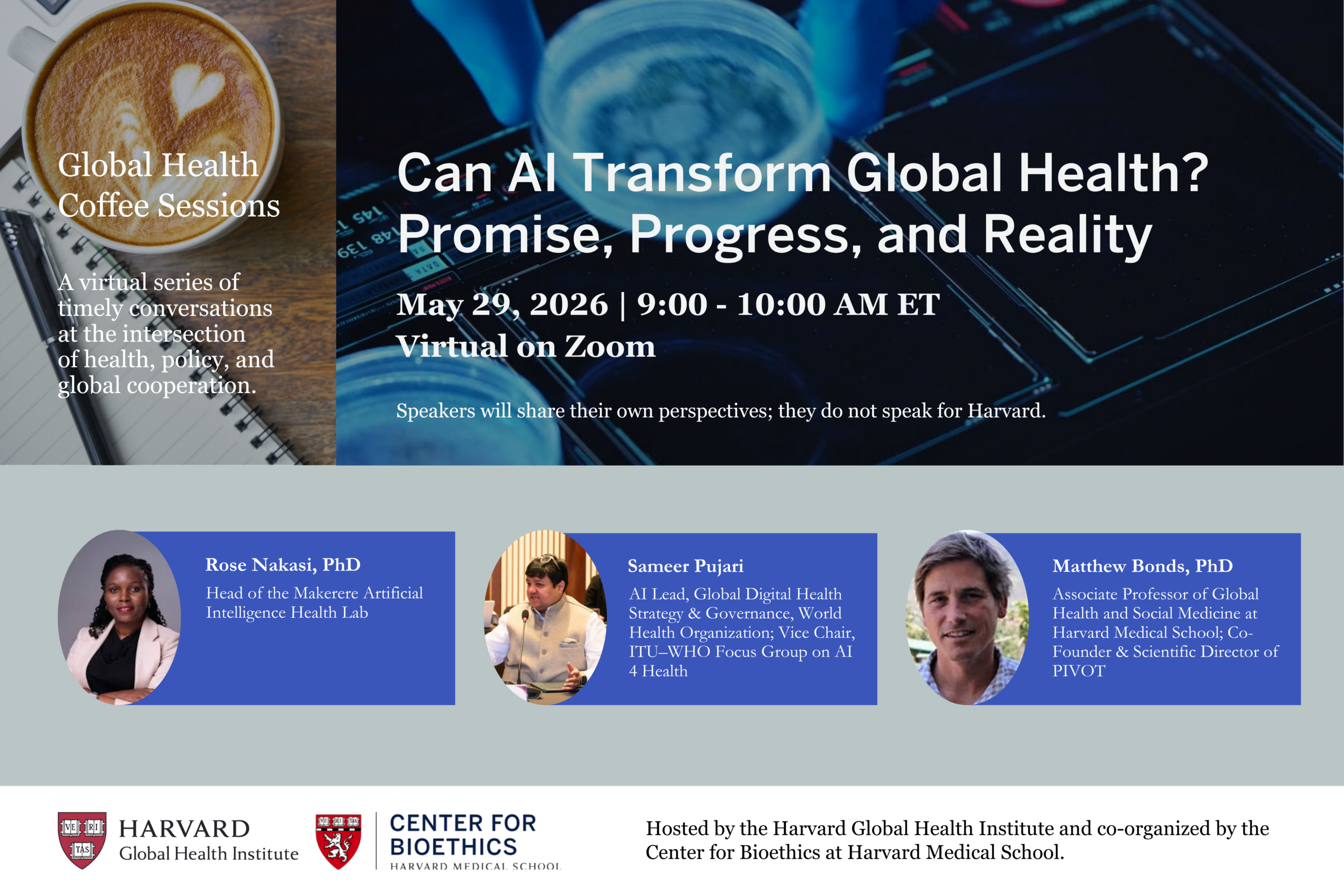
Can AI Transform Global Health? Promise, Progress, and Reality
This session examines the state of AI in global health through a central question: with governments and donors now actively shaping AI policy for health, how do we ensure the evidence base and frontline capacity keep pace with the speed of deployment, and where does hype outpace the evidence? Speakers will explore persistent gaps in health systems, from workforce shortages and delayed diagnostics to fragmented data systems and outbreak preparedness, alongside the growing landscape of AI applications designed to address them. The discussion will critically examine recurring misalignments between donor priorities, technology development, and frontline health worker needs, while also considering the practical realities that shape implementation.
Hosted by the Harvard Global Health Institute and co-organized by the Center for Bioethics at Harvard Medical School.
This webinar is free and open to the public and will conclude with a live Q&A session.
Speakers

Rose Nakasi, PhD
Head of the Makerere Artificial Intelligence Health Lab
Dr. Rose Nakasi, an Artificial Intelligence Research Scientist and Lecturer at Makerere University, is breaking new ground in health technology as the Head of the Makerere Artificial Intelligence Health Lab. She spearheads innovative projects like the Lacuna-funded initiative for Sexual Reproductive and Maternal Health and the Google-funded “Ocular” project, focusing on AI-driven mobile microscopy diagnosis of Malaria, Tuberculosis, and cancer. Her dedication to healthcare is evident through her work with the NIH DS-I Africa consortium on the DS-I Malaria project in Uganda. With a PhD in Computer Science from Makerere University, Rose is making significant strides in AI and health technology. Rose also leads the ITU/WHO/WIPO Topic Group on “AI based detection of Malaria” under the Global Initiative AI for Health (GIAI4H) and a committee member on the CODATA International Data Policy Committee.

Sameer Pujari
AI Lead, Global Digital Health Strategy & Governance, World Health Organization; Vice Chair, ITU–WHO Focus Group on AI 4 Health
Sameer Pujari is currently leading WHO AI for Health Programme and heads the WHO Secretariat for the Global Initiative on AI for Health, a joint initiative with WHO, ITU and WIPO where he is convening global AI labs, leading development and deployment of standards, policies, and norms on AI for health, building benchmarking and evaluation frameworks for verifiable AI in health, and shaping AI readiness for WHO and its Member States. He previously led the development and negotiations of the WHO Global Strategy on Digital Health across all 194 Member States. He has also served as Vice Chair of the WHO–ITU Focus Group on AI for Health.
Sameer joined WHO Headquarters in Geneva in February 2008. Over his career, he has worked extensively on digital health — spanning mHealth, big data, and AI — and has established several global digital health initiatives. He has provided in-country support across 75+ countries in all WHO regions and has contributed to close to 100 publications, guidance documents, and reports on digital health and AI. He is a recipient of the WHO Director-General’s Award for Excellence (2016) and the Greenpeace Innovations Award (2018).
Moderator

Matthew Bonds, PhD
Associate Professor of Global Health and Social Medicine at Harvard Medical School; Co-Founder & Scientific Director of PIVOT
Professor Matthew Bonds has a PhD in economics and a PhD in (disease) ecology from the University of Georgia. He is an associate professor of global health and social medicine at Harvard Medical School, and co-founder & scientific director of PIVOT. His research focuses on 1) the ecology of poverty and economic development; and 2) the science of implementing global health delivery systems. PIVOT works with the Madagascar government to establish a district level model health system for over 200,000 people. With novel data systems at all levels of care (community, primary and secondary care), this partnership is pioneering a new science of health system transformation, with some of the most rigorously evaluated population level impacts in the world. His work has been supported by a K01 Award from the NIH Fogarty International Center, a Scholar Award in Complex Systems Science from the James S. McDonnell Foundation, and a Rainer Arnhold Fellowship from the Mulago Foundation.
About the Global Health Coffee Sessions
The Global Health Coffee Sessions is a virtual series of timely conversations on wide-ranging topics at the intersection of health, policy, and global cooperation. The series brings together global health experts, policymakers, and practitioners from Harvard and beyond for dynamic, forward-looking discussions.
All sessions are hosted virtually via Zoom, recorded, and available afterward on our YouTube Channel.
The Harvard Global Health Institute provides a platform for different perspectives and debates within the field of global health through a variety of media. The views expressed in these events and programs are solely those of the speakers, authors, researchers, and participating audience. As such, they do not speak for the institute or the university.