


November 10, 12:00 pm - 12:45 pm
FreeHow Abortion Criminalization Affects Maternal Health in Cases of Severe Fetal Anomaly: Insights from El Salvador
-
 Jocelyn Viterna, PhD
-
 Jacqueline Bhabha, JD, MSc
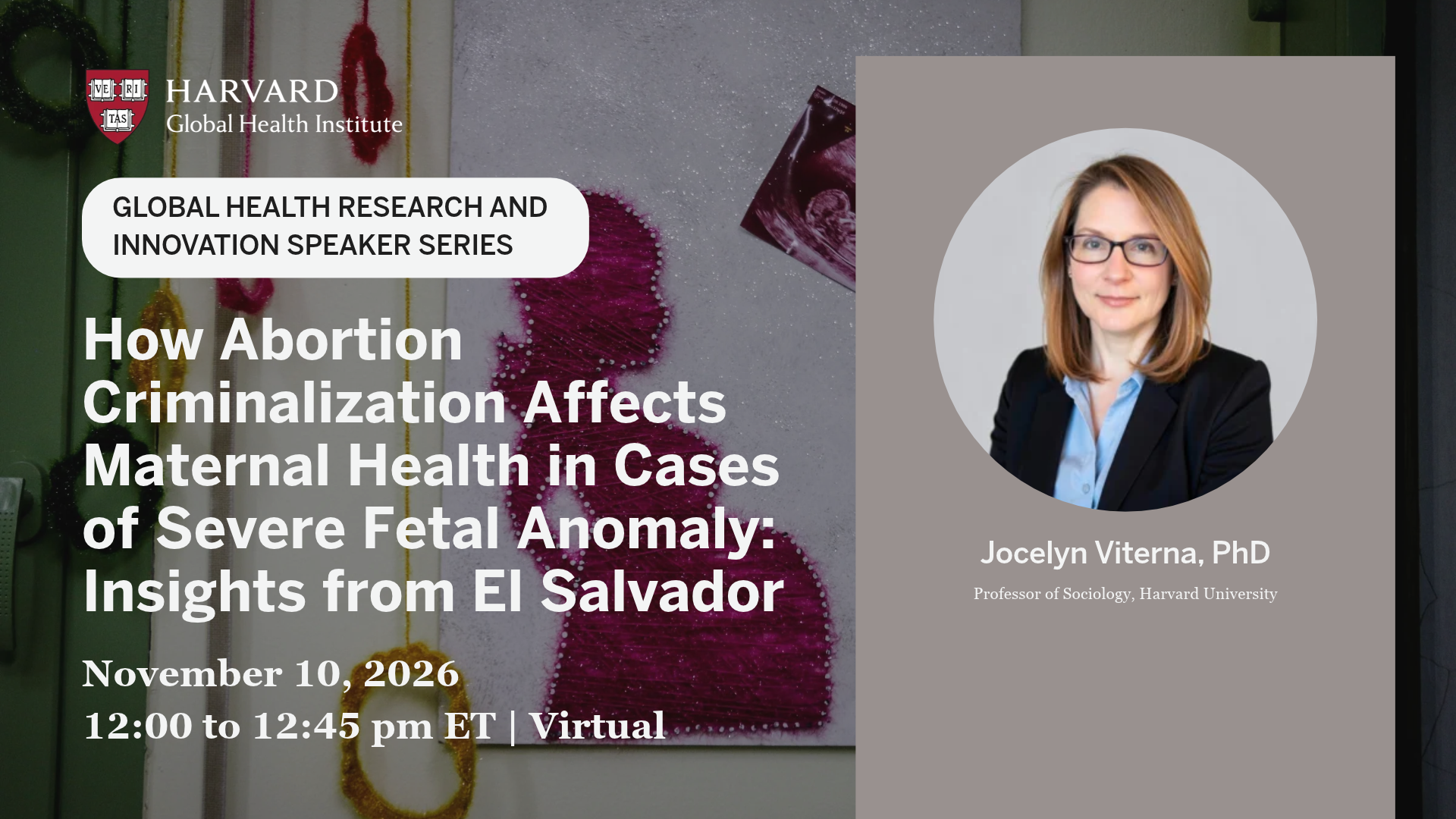
What are the maternal health consequences of criminalizing abortion in pregnancies with severe fetal anomaly? To answer this question, Professor Viterna and her colleagues reviewed the charts of all 239 pregnancies diagnosed with fatal fetal anomalies at the National Women’s Hospital in El Salvador between January 1, 2013, and December 31, 2018. In El Salvador, all abortion is criminalized, regardless of fetal viability. Anti-abortion advocates justify this ban by arguing that non-viable fetuses deserve a “natural” death, but this study shows how notions of “natural” become nonsensical in health care settings, where medical interventions are frequently required to manage pregnancy and initiate birth. The findings further demonstrate that requiring women to carry nonviable pregnancies to “term” generates serious and avoidable maternal health complications, which must be managed through physically invasive medical procedures, including cesarean deliveries, decompression amniocenteses, fetal head decompressions, and, in one case, a full hysterectomy.
In this talk, Professor Viterna will present findings from the study and discuss the maternal health consequences of abortion criminalization in cases of severe fetal anomaly, including implications for reproductive health policy in the United States.
This webinar is free and open to the public and will include time for audience Q&A.
Speaker

Jocelyn Viterna, PhD
Professor of Sociology, Harvard University
Jocelyn Viterna is Professor of Sociology at Harvard University. Her research examines how social mobilization affects gender norms and practices in states, in warfare, in institutions, and in communities. Viterna’s current project investigates how anti-abortion-rights activism in El Salvador transformed the Salvadoran judicial system, and more specifically, its processes for litigating gender. Viterna has also collaborated with Salvadoran doctors to investigate the maternal health outcomes of strict anti-abortion legislation. She is currently working on a book that elaborates how these lessons from El Salvador foreshadow institutional changes to US legal and health care systems under Dobbs. To date, Viterna’s articles have been published in the American Journal of Sociology, the American Sociological Review, Politics and Gender, and the Latin American Research Review. Her award-winning book, Women in War: The Micro-processes of Mobilization in El Salvador was published in 2013 by the Oxford University Press.
Moderator
Jacqueline Bhabha, JD, MSc
Professor of the Practice of Health and Human Rights, Harvard T.H. Chan School of Public Health; Jeremiah Smith, Jr. Lecturer in Law, Harvard Law School; Adjunct Lecturer in Public Policy, Harvard Kennedy School
Jacqueline Bhabha is a Professor of the Practice of Health and Human Rights at the Harvard T. H. Chan School of Public Health, the Jeremiah Smith Jr. Lecturer in Law at Harvard Law School, and an Adjunct Lecturer in Public Policy at the Harvard Kennedy School. She is also the Director of Research at the FXB Center for Health and Human Rights at Harvard University. She received a first class honors degree and an M.Sc. from Oxford University, and a J.D. from the College of Law in London.
From 1997 to 2001, Bhabha directed the Human Rights Program at the University of Chicago. Prior to 1997, she was a practicing human rights lawyer in London and at the European Court of Human Rights in Strasbourg. She has published extensively on issues of transnational child migration, refugee protection, children’s rights and citizenship. She is the author of Child Migration and Human Rights in a Global Age (2014) and Can We Solve the Migration Crisis? (2018). She has edited or co-edited many books, including Children Without A State (2011), Human Rights and Adolescence (2014), Research Handbook on Child Migration (2018), A Better Future: The Role of Education for Displaced and Marginalized People (2020), and Time for Reparations: A Global Perspective (2021). Bhabha was the founding chair of the Scholars at Risk Network, and she serves on the board of the World Peace Foundation, the Institute for Statelessness and Inclusion, Fortify Rights, the Journal of Refugee Studies and the Journal on Migration and Human Security.