Filter by

Changing any of the form inputs will cause the list of events to refresh with the filtered results.

Research and Innovation Speaker Series

Rethinking American Indian Mental Health Services: Explorations in Alter-Native Psy-ence

Virtual: Zoom
Since the early stages of his career, Joseph P. Gone has been examining depression and problem drinking within his own community on the Fort Belknap Indian Reservation in Montana. During this work, he interviewed a cultural traditionalist named Traveling Thunder, who linked substance abuse challenges to the historical and ongoing impacts of Euro-American colonization on community life. Building on these insights, Professor Gone proposes an alternative Indigenous mental health discourse, an “alter-Native psy-ence”, that contests and recasts mainstream psychiatric concepts and reframes “mental health” problems as postcolonial disorders.

Coffee Sessions
Virtual
Coffee Sessions
Virtual
Event Series Coffee Sessions

Models of Global Collaboration: Practical Approaches to Vaccine Access

The evolving landscape of global health funding and shifting priorities are redefining how we work together. Countries are reshaping how they address the direct impact on critical health infrastructure by strengthening new and existing collaborations between governments and the private sector. Vaccine delivery is one area where these partnerships are already achieving positive results. Join us for a focused discussion on how nations are advancing local vaccine manufacturing to accelerate health equity. Our panel of experts will offer insights into what national ownership looks like for vaccine development and distribution today, especially as traditional donor support declines. Whether you are a current or future health professional, policymaker, advocate, or researcher, you will gain valuable perspectives on how countries are shaping the future of vaccines and health systems amid shifting global support.
Virtual
Virtual

Bridging Disciplines, Advancing Solutions: Harvard’s Global Health Collaborations

  As part of Harvard Worldwide Week, this event showcases the impact of the Harvard Global Health Institute’s Scholarly Working Group (SWG) Program, an initiative that brings together faculty across Harvard’s schools, departments, and centers to collaborate on pressing global health challenges. Harvard faculty from current and past SWGs will share how the program has fostered interdisciplinary dialogue, generated key research deliverables, and sparked innovative events and convenings. From advancing health justice in conflict zones to responding to the health threats of climate change and beyond, these working groups exemplify how cross-campus collaboration enhances Harvard’s global health efforts.  Join us to learn how the SWG Program supports intellectual partnerships, builds research communities, and drives forward-thinking solutions in global health within Harvard and beyond. This event is free and open to the public.   Agenda Networking Health Care Providers Confronting Climate Change Megan Murray, MD, MPH, ScD Choose Your Future: Climate Change, War, and Health in the Next 50-100 Years Tina Duhaime, MD Increasing the Resilience of Threatened Health Systems Margaret Bourdeaux, MD, MPH   Register   Featured Panelists Megan Murray, M.D., Sc.D. Ronda Stryker and William Johnston Professor of Global Health and Social Medicine at Harvard Medical School and Professor of Epidemiology at the Harvard Chan School of Public Health Megan Murray, MD, MPH, ScD is an epidemiologist and an infectious disease physician with over 25 years of experience in the management of TB programs and TB epidemiology, as well as the transmission dynamics of emerging infectious diseases. She is a Professor of Global Health and Social Medicine and an Associate Professor of Medicine at Harvard Medical School, where she leads the Global Health Research Core, a multidisciplinary group of researchers who work with the Global Health Delivery Partnership faculty and staff to develop its mission to link research to the teaching and service activities of the Partnership. She is also a Professor of Epidemiology at Harvard School of Public Health and the Director of Research at the Brigham and Women’s Hospital Division of Global Health Equity and its sister organization, Partners In Health. Dr. Murray has conducted field studies in Peru, Rwanda, South Africa, Ukraine, Russia and the US, and has previously worked in Kenya, Niger and Pakistan. Her current interests include identifying ways to reduce the suffering caused by the health impacts of climate change, especially in low and middle income countries. Dr. Murray led the Harvard Global Health Scholarly Working Group titled the Climate Change and Health Collaborative.   Ann-Christine Duhaime, M.D. Nicholas T. Zervas Professor of Neurosurgery at Harvard Medical School Dr. Duhaime is a pediatric neurosurgeon at the Massachusetts General Hospital and Professor of Neurosurgery at Harvard Medical School. Her research has focused on traumatic brain injury and recovery in children, and more recently on climate change, war, and health. Her longstanding interest in the relationship between brain, behavior and environmental issues was explored in her 2022 book, Minding the Climate (Harvard University Press). She serves as Associate Director of the Mass General Center for the Environment and Health, as Faculty Associate at Harvard Salata Institute and at the Harvard Global Health Institute, and as Associate Editor-in-Chief of the Journal of Climate Change and Health. Dr. Duhaime led the Harvard Global Health Scholarly Working Group on Climate Change, War, and Health: Effects of Intergenerational Global Health Adaptation.   Margaret Bourdeaux, MD, MPH Assistant Professor at Harvard Medical School; Associate Physician at Brigham and Women’s Hospital Margaret Bourdeaux, MD, MPH, is an Assistant Professor at Harvard Medical School and an Associate Physician at Brigham and Women’s Hospital, where she also serves as the Director of the Health Security Policy Academy in the Division of Global Health Equity. Her professional affiliations extend to being a Faculty Affiliate at Harvard University’s Berkman Klein Center for the Internet and Society and a member of the Steering Committee for the Massachusetts Consortia of Pathogen Readiness. Dr. Bourdeaux conducts research and fieldwork focused on health systems and institutions in conflict affected states. Her research interests lie at the intersection of health, international security, and domestic and global health policy. Dr. Bourdeaux leads the Harvard Global Health Scholarly Working Group titled Increasing the Resilience of Threatened Health Systems.   About the Harvard Global Health Institute's Scholarly Working Groups The Harvard Global Health Institute’s Scholarly Working Groups are designed to encourage a collaborative environment, promote inter-faculty gatherings, and explore and accelerate research areas in topics critical to the advancement of “Health for All”. Each Scholarly Working Group includes faculty from at least two schools across Harvard University. Through these working groups, we aim to catalyze ideas, inspire the writing of grants, policy briefs, or working papers, or build networks to advance a program of work. Through our events and programs, the Harvard Global Health Institute provides a platform for different perspectives and debates within the field of global health through a variety of media. The views expressed in these events and programs are solely those of the speakers, authors, researchers, and participating audience. As such, they do not speak for the institute or the university.
In-person
In-person

Careers in Global Health: Pathways, Challenges, and Opportunities

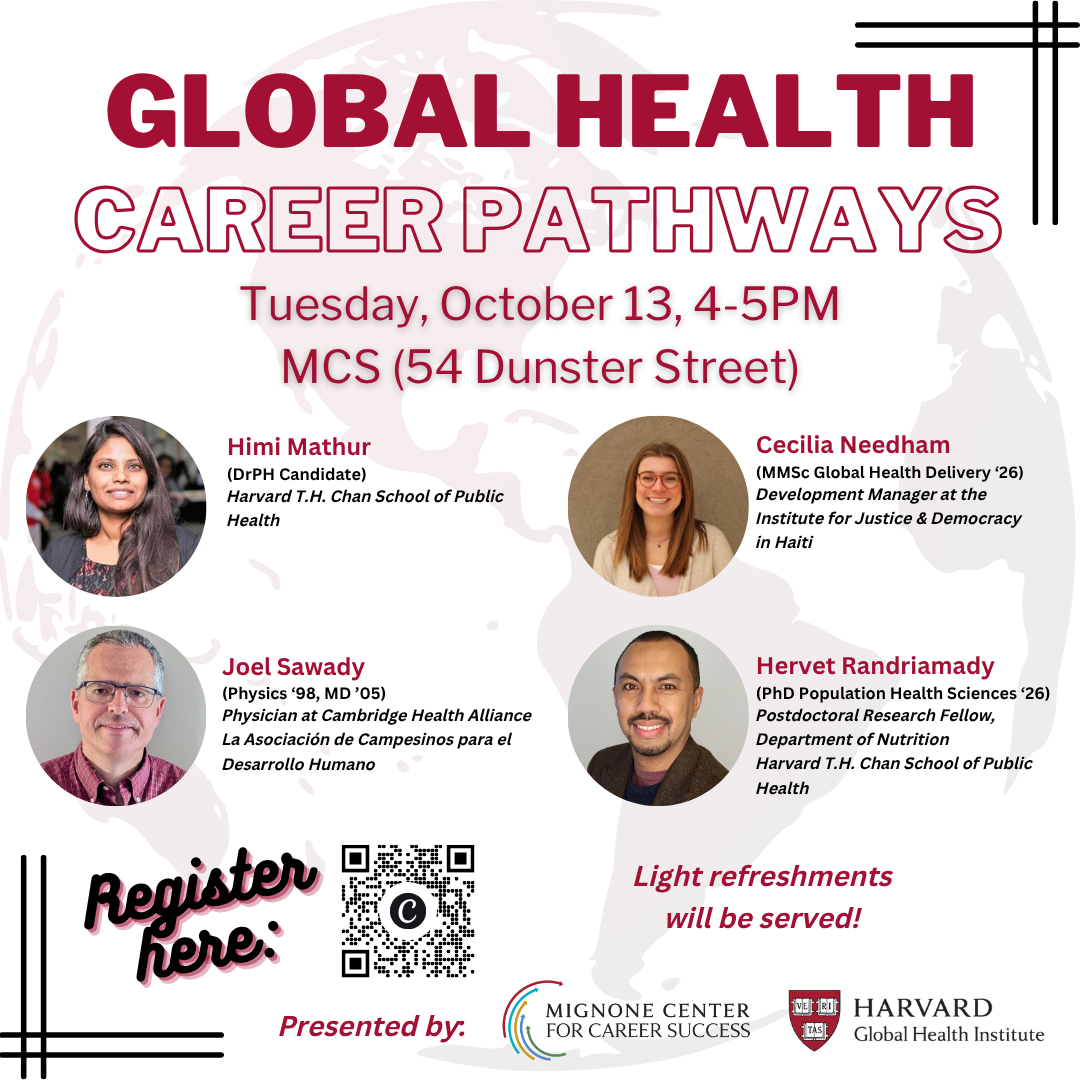
  Interested in a future career in global health? As part of Worldwide Week at Harvard, we invite you to join us in-person at the Mignone Center for Career Success for an engaging panel featuring experts from Harvard Medical School, the School of Public Health, and the Business School. They’ll share their journeys into the field, the skills that helped them succeed, tips for finding meaningful experiences (in the U.S. and abroad), and their thoughts on where the field of global health is headed. Whether you're just exploring or already planning your path, this is a great chance to learn, ask questions, and get inspired! Panelists will share candid insights on refining your focus, landing your first global health job, and overcoming uncertainty. This event includes a Q&A session for you to get personalized advice and discover the wide-ranging career paths and opportunities in global health. Agenda Panel Discussion: ~45 minutes Audience Q&A: ~15 minutes Optional 1:1 Conversations with Panelists (Post-event): ~15 minutes This event is available to current Harvard graduate and undergraduate students. Register   Featured Panelists Jessica Cohen, PhD Professor of Health Economics at Harvard T.H. Chan School of Public Health Jessica Cohen is a Professor of Health Economics at the Harvard T.H. Chan School of Public Health, where she focuses on health policy, behavioral economics, and maternal and child health. Her research examines how health systems, policies, and programs influence maternal and newborn health in the U.S. and East Africa with the aim of embedding this evidence into policy design and increasing policy impact. Dr. Cohen was a member of the WHO Global Malaria Program's Technical Expert Group on Surveillance, Monitoring and Evaluation and has served on NIH expert review panels related to implementation science and impact evaluation. She has also co-authored the behavioral economics chapter in the textbook Health Behavior: Theory, Research, and Practice. Her contributions have been recognized through honors like the Alice Hamilton Award and the National Academy of Medicine Healthy Longevity Catalyst Award.   Daniel Palazuelos, MD, MPH Assistant Professor of Medicine, HMS; Director of Community-Centered Medical Education, HMS; Director of Community Health Systems, PIH Daniel Palazuelos, MD, MPH is a community health implementer-educator who holds positions at Harvard Medical School (HMS), the Brigham and Women's Hospital (BWH), and Partners In Health (PIH). He started his career in global health equity by living and working with community health workers (CHWs) in impoverished communities in Chiapas, Mexico, and these grassroots experiences have deeply influenced his approach to addressing the biggest challenges in global health. He worked over two decades to launch Compañeros En Salud - México (CES, PIH's program in Mexico), the Financing Alliance for Health (FAH, which helps governments design and fund ambitious, affordable, and at-scale community health programs), and the Community Health Impact Coalition (CHIC, an advocacy, research and organizing initiative led by many of the most innovative implementers in community health). His unified goal is to assure that our finest clinicians are trained to understand the community perspective, and our health care system strengthening efforts are aligned to the real needs of people living in the poorest and most difficult circumstances.   Chuan-Chin Huang, ScD, MSc Associate Epidemiologist at Brigham and Women’s Hospital; Instructor at Harvard Medical School Chuan-Chin Huang, Sc.D., is an epidemiologist and biostatistician dedicated to advancing global health equity and infectious disease research, particularly tuberculosis. Currently, he serves as an Associate Epidemiologist at the Division of Global Health Equity at Brigham and Women’s Hospital and as an Instructor at Harvard Medical School. Dr. Huang has been involved in numerous interdisciplinary projects focused on understanding bacterial and host factors associated with TB outcomes. His work integrates pathogen and host genomics, clinical, and epidemiologic data from longitudinal field studies conducted in Lima Peru. His research has significantly contributed to understanding the transmission dynamics and epidemiology of multidrug-resistant and extensively drug-resistant TB. Ultimately, his goal is to use data to identify optimal TB control and treatment strategies, reducing morbidity and mortality from this deadly disease.   Ashley V. Whillans, PhD, MA Volpert Family Associate Professor of Business Administration, Harvard Business School Ashley Whillans is the Volpert Family Associate Professor of Business Administration in the Negotiation, Organizations & Markets Unit at Harvard Business School, where she teaches Motivation course to MBA students. Her research explores the intersection of behavioral science and organizational effectiveness, investigating how intangible incentives—such as experiential and time-saving rewards—impact employee motivation, well-being, and performance. Professor Whillans' work examines the critical relationships between time, money, and happiness, with relevance to public health through her focus on stress reduction, work-life balance, and psychological well-being. Her research extends globally, with ongoing projects in the Thar Desert region of India and Nairobi, Kenya, examining how time-use patterns affect health and quality of life across diverse populations. As a 2019 Burke Global Health Fellow at Harvard, she conducted a large-scale field experiment with 1,200 financially constrained working mothers in Kibera, Kenya—the largest informal settlement in East Africa—focusing on alleviating "time poverty" among women in developing markets.   Moderator Princess Magor Agbozo Graduate Student at the Harvard T.H. Chan School of Public Health Princess Magor Agbozo is a Master of Science student in Global Health and Population at the Harvard T.H. Chan School of Public Health. She holds a bachelor’s in Public Health from the University of Kentucky. During her undergraduate studies, Agbozo worked as an intern in the Division of Epidemiology and Health Planning in the Kentucky Department for Public Health, supporting perinatal epidemiologists with surveillance projects to determine substance use in Hepatitis C Virus (HCV) positive mothers. She has also conducted community-engaged research focused on crisis management, maternal and child health, and cervical cancer. Her current research interest lies in health systems strengthening and cross-sector partnerships between faith-based organizations and public health institutions to improve population health and well-being.   About the Harvard Global Health Institute The Harvard Global Health Institute (HGHI) is an interfaculty initiative that facilitates collaboration across the Harvard community and partners worldwide to advance global health equity. We tackle the greatest health challenges of our time through innovative transdisciplinary research, education, and partnerships that build knowledge and drive positive change in global health.
In-person
student engagement
In-person
student engagement

Socially Responsible Business in Global Health: A Presentation and Moderated Discussion with Dr. Lutz Hegemann

37 Harvard Way, Boston, MA, United States
The Harvard Global Health Institute, the HBS Social Enterprise Club, HBS Healthcare Club, and the HKS Health Policy PIC invite you to a student-facilitated discussion with Dr. Lutz Hegemann, President of Novartis Global Health, on Friday, October 10, 4–5pm in Hawes 101. Dr. Hegemann will provide an overview of Novartis’ initiatives to increase access to medicines in low- and middle-income countries. Student facilitators will then guide a critical conversation on the intersections of business responsibility and equity in global health.

Research and Innovation Speaker Series
Virtual
Research and Innovation Speaker Series
Virtual

The Ethics of Priority Setting in Global Health

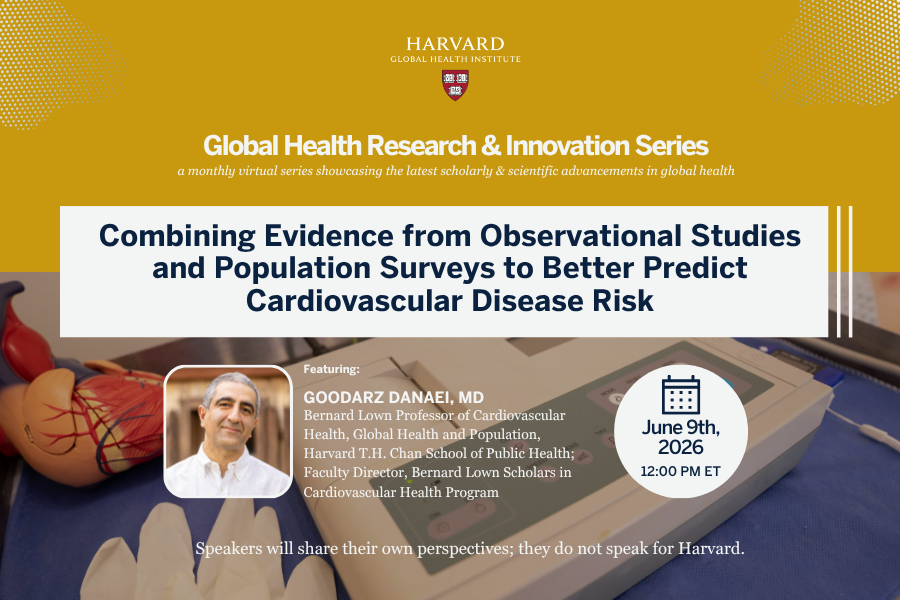
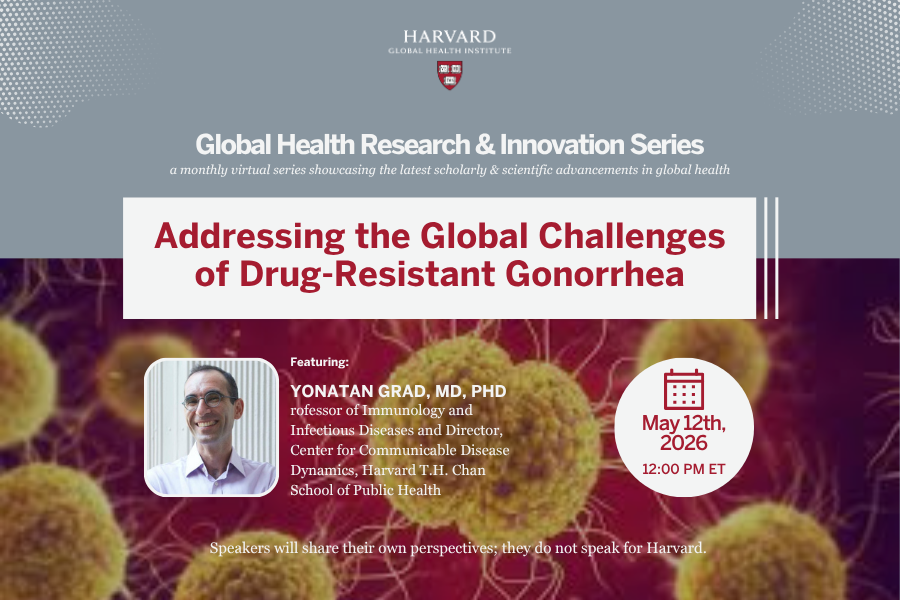
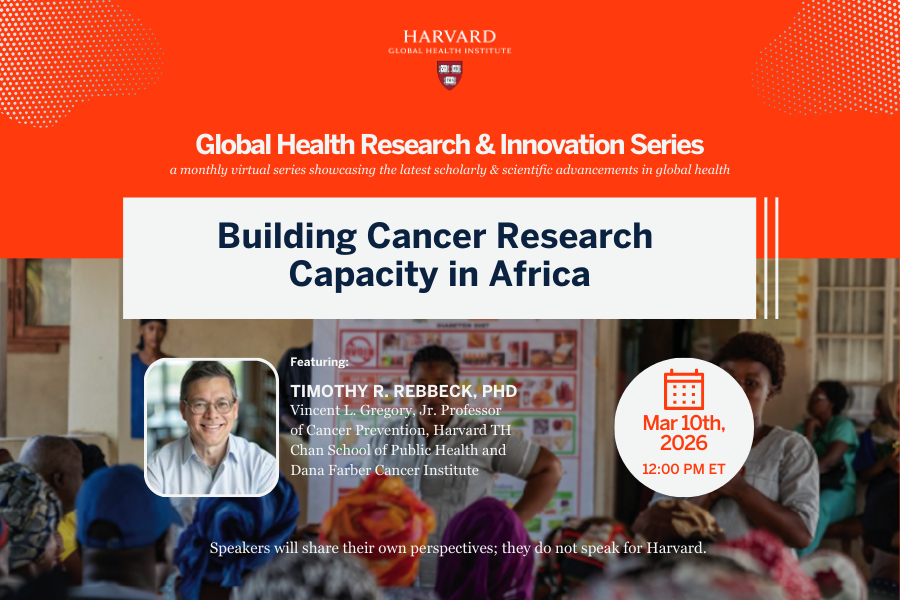
The Harvard Global Health Institute’s Global Health Research and Innovation Speaker Series showcases the latest scholarly and scientific advancements in global health across Harvard and beyond, to make cutting-edge research accessible to a diverse global audience, and to spark innovative solutions in the pursuit of health equity and improved health outcomes worldwide. The public series takes place virtually on the second Tuesday of each month from 12:00 to 12:45 pm ET. Each session will include a presentation by a featured speaker showcasing their innovative research in global health, followed by a moderated Q&A.
Coffee Sessions
Virtual
Coffee Sessions
Virtual
Event Series Coffee Sessions

Global Health as a Moral Imperative: The U.S. Role in Advancing Equity and Partnership

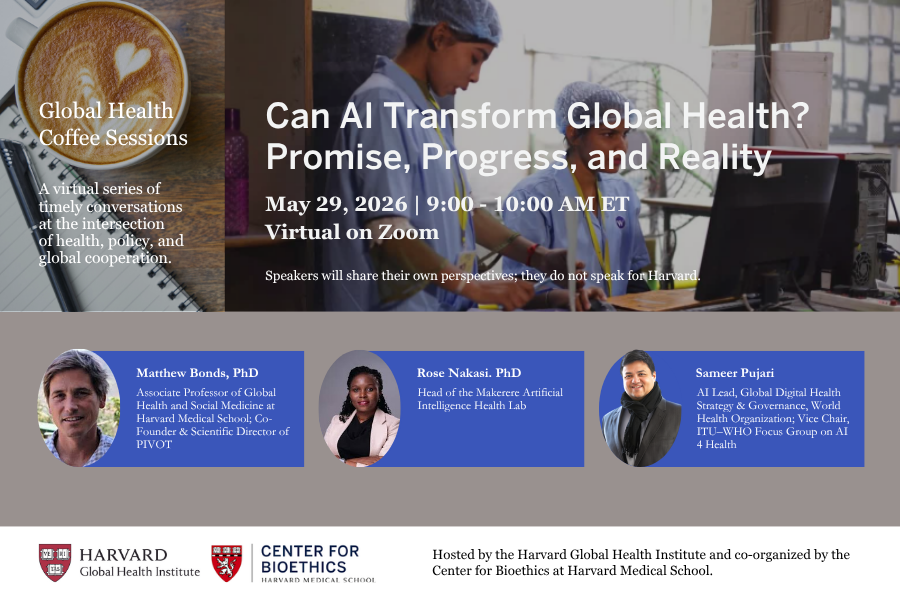
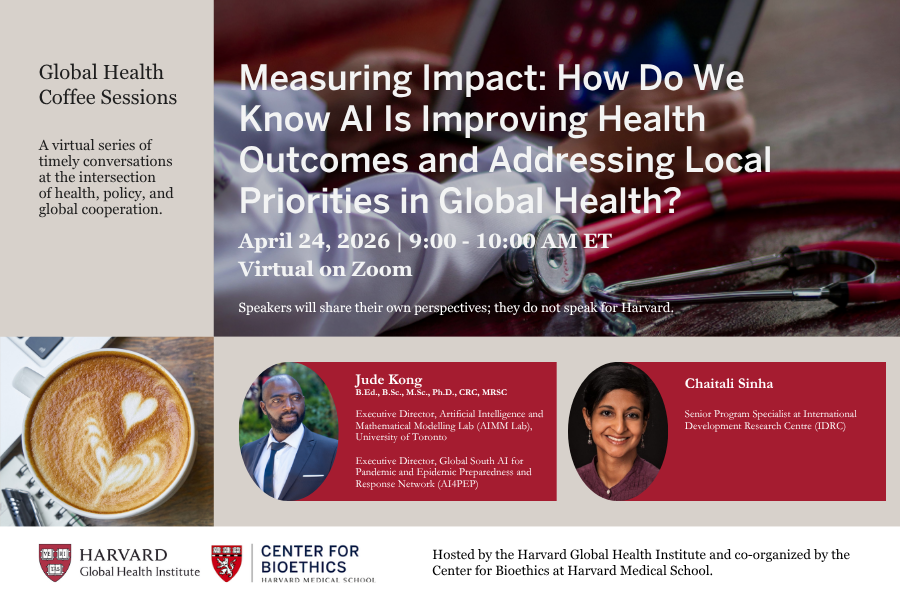
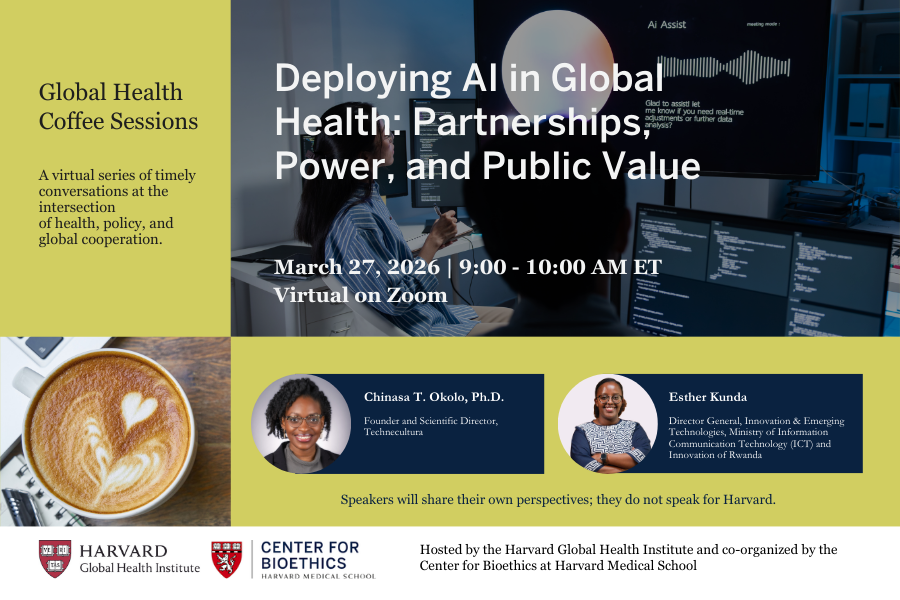
The Global Health Coffee Sessions is a virtual series of timely conversations on wide-ranging topics at the intersection of health, policy, and global cooperation. Held on the last Friday of each month from 9:00–10:00 AM ET, this series brings together global health experts, policymakers, and practitioners from Harvard and beyond for dynamic, forward-looking discussions.

The Future of Global Health: Learning from a Decade of Impact in Madagascar

59 Shepard St., Cambridge, MA, United States
  This event invites you into a critical conversation on the impacts of global health interventions in a changing funding landscape through the example of Pivot, a nonprofit organization working in Madagascar since 2014 to strengthen the public health system, improve access to high quality care, and save lives in one of the world’s most under-resourced regions. Over the past decade, Pivot’s community-driven, science-backed approach has contributed to significant drops in maternal and child deaths, while doubling the likelihood that families seek care when they need it. Drawing on this real-world impact, Pivot’s experience with the Madagascar government offers lessons on how humility, partnership, and science can rebuild trust and improve outcomes at a fragile moment for global health. Join us for a presentation of Pivot’s impact data followed by a panel discussion with frontline clinicians, policy-makers, and researchers to explore these innovative approaches and hear directly from leaders shaping the future of global health delivery. We will have time for your questions and meaningful dialogue. Light refreshments will be provided. This event highlights the work of Matt Bonds, drawing on his experience as a former Burke Fellow and current faculty member at Harvard Medical School. The program will focus on his research and related initiatives at Pivot, the non-profit organization he co-founded. Please note that all speakers are presenting in their personal capacities; they do not speak for Harvard University, and their participation does not imply the University's endorsement of their views or affiliated organizations. This event is free and available to HUID cardholders and in person only. A recording will be shared post event. Register   Featured Speakers & Panelists Matthew Bonds, Ph.D Co-founder of Pivot; Associate Professor at Harvard Medical School Matthew Bonds is an associate professor of global health and social medicine at Harvard Medical School, cofounder of Pivot, and former Burke Fellow. He has a PhD in economics and a PhD in ecology and is broadly interested in complex systems in health and economic development. His research includes mathematical and statistical modeling of coupled human-ecological systems, as well as field-based implementation science. Pivot partners with the Madagascar government to establish a model system of healthcare in a region of one million people. With novel data systems at all levels of care (community, primary and secondary), the partnership aims to lead a science of health system transformation.   Carole Mitnick, ScD Professor, Global Health and Social Medicine, Harvard Medical School Dr. Mitnick has worked for more than 25 years to increase access to high-quality, appropriate treatment for TB, especially for drug-resistant TB. Together with collaborators and mentees around the world, she leverages research, training, policy, programmatic support, activism, and advocacy to advance global health equity. She also works to improve our understanding of post-TB lung impairment. Dr. Mitnick is also Senior Research Associate at Partners In Health and Associate Epidemiologist in the Division of Global Health Equity at Brigham & Women’s Hospital. She received her doctoral training in international health epidemiology and ecology at the Harvard TH Chan School of Public Health.   Luc Hervé Samison, MD Pivot Steering Committee Chair; President of the Global Fund Country Coordinating Mechanism Luc Hervé Samison is a distinguished physician and health leader in Madagascar. He currently serves as President of the Country Coordinating Mechanism for the Global Fund grant in Madagascar and as Director of the Centre d’Infectiologie Charles Mérieux. Formerly the Dean of the Faculty of Medicine at the University of Antananarivo, Professor Samison brings decades of expertise in medicine, surgery, and infectious diseases to his roles. Since joining the Pivot Board in February 2021, he has contributed invaluable insights, having closely followed Pivot’s work from its inception. Professor Samison has played a pivotal role in advancing the district-level health system model that now informs Madagascar’s national universal health coverage strategy. Deeply committed to addressing critical challenges in health care, he is particularly passionate about improving the retention of trained clinical staff in rural health centers — a pressing issue for both Pivot and the country at large. Professor Samison’s leadership continues to inspire meaningful progress toward equitable health care access in Madagascar.   Luc Rakotonirina Pivot Deputy Country Director Luc Rakotonirina joined Pivot in 2014. A trained nurse and paramedic, he was a member of Pivot’s founding clinical team. Luc currently serves as Pivot's Deputy Country Director, where he oversees strategic relationships with the Ministry of Public Health and provides day-to-day support for clinical teams. Luc played a key role in establishing Madagascar’s first 24/7 public ambulance network — an accomplishment that has been recognized at the national level by the Ministry of Health — and was instrumental in shaping the 2022 national community health guidelines which cemented Madagascar's progress toward a professionalized community health workforce.   Moderator Joia S. Mukherjee, MD, MPH Chief Medical Officer, Partners In Health; Director and Advisory Dean, F.W. Peabody Society; Director, Master in Medical Science in Global Health Delivery, Harvard Medical School; Associate Professor of Medicine, Brigham and Women’s Hospital Dr. Joia Mukherjee is an associate professor in the Division of Global Health Equity at Brigham and Women’s Hospital and in the Department of Global Health and Social Medicine at Harvard Medical School. She leads the Master of Medical Sciences in Global Health Delivery and the Program in Global Medical Education and Social Change. Since 2000, Dr. Mukherjee has been the chief medical officer at Partners In Health, where she provides strategic oversight for clinical programs across sites in Haiti, Rwanda, Malawi, Lesotho, Peru, Mexico, Russia, Sierra Leone, and Liberia. She has advised the WHO and numerous Ministries of Health on HIV, TB, health systems strengthening, and workforce development. Dr. Mukherjee also serves on the boards of Village Health Works (Burundi), Muso (Mali), and the Institute for Justice and Democracy in Haiti.   About the Harvard Global Health Institute The Harvard Global Health Institute (HGHI) is an interfaculty initiative that facilitates collaboration across the Harvard community and partners worldwide to advance global health equity. We tackle the greatest health challenges of our time through innovative transdisciplinary research, education, and partnerships that build knowledge and drive positive change in global health.
Research and Innovation Speaker Series
Virtual
Research and Innovation Speaker Series
Virtual

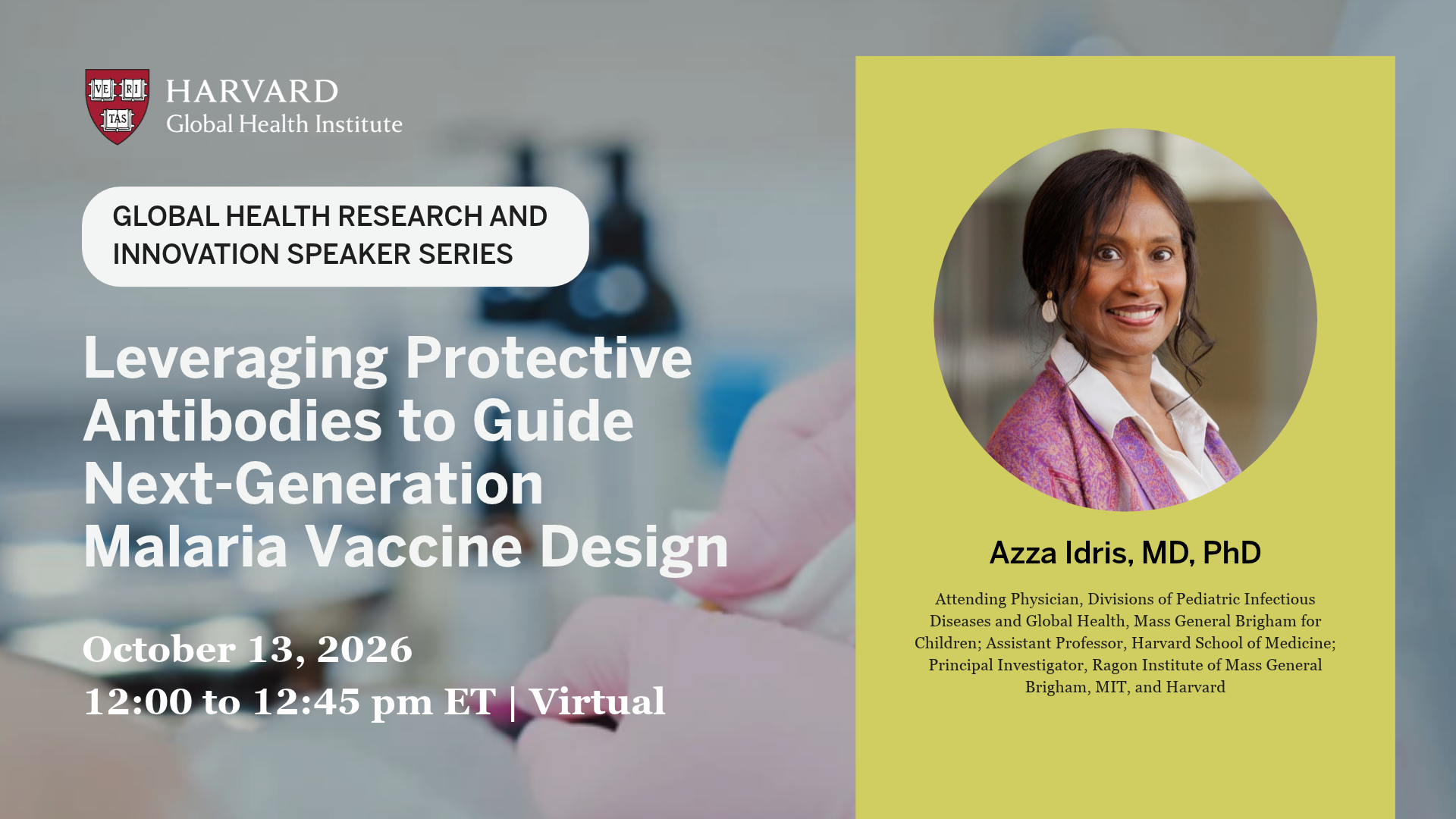
Randomized Trial of Single-Dose HPV Vaccination in Young Women: 54-Month Efficacy and Durability

The Harvard Global Health Institute’s Global Health Research and Innovation Speaker Series showcases the latest scholarly and scientific advancements in global health across Harvard and beyond, to make cutting-edge research accessible to a diverse global audience, and to spark innovative solutions in the pursuit of health equity and improved health outcomes worldwide. The public series takes place virtually on the second Tuesday of each month from 12:00 to 12:45 pm ET. Each session will include a presentation by a featured speaker showcasing their innovative research in global health, followed by a moderated Q&A.

Coffee Sessions
Virtual
Coffee Sessions
Virtual
Event Series Coffee Sessions

Financing Global Health’s Future: Beyond the Budget Cuts

The Global Health Coffee Sessions virtual series pivots with a new lineup of timely conversations at the intersection of health, policy, and global cooperation. Held on the last Friday of each month from 9:00–10:00 AM ET, this series brings together global health experts, policymakers, and practitioners from Harvard and beyond for dynamic, forward-looking discussions.

Coffee Sessions
Virtual
Coffee Sessions
Virtual
Event Series Coffee Sessions

Stating The Facts: The Rise of Misinformation and Distrust in Science

Join Heidi J. Larson and Seth Mnookin for the final installment of our series on navigating the complexities of health information in the U.S., presented in partnership with the Harvard Center for International Development. This discussion will explore how to critically evaluate pressing health issues, distinguish between misinformation, disinformation, and differing opinions, and assess the evolving role of media in shaping public understanding.