

Filter by

Changing any of the form inputs will cause the list of events to refresh with the filtered results.

Global Mental Health

GMH@Harvard Research Seminar – Shamiri: Supporting Youth Mental Health in Kenya via Scalable Low-Stigma Intervention

Click here to register and receive the zoom link!  Abstract Depression and anxiety make up an estimated 45% of the global burden of disease for young people, and both are associated with many negative life outcomes. This burden falls disproportionately on low-income countries, such as Kenya, where a high percentage of youths report clinically elevated symptoms of depression or anxiety. However, these young people rarely receive treatment due to a dearth of mental health providers, elevated stigma related to mental illness, and low availability of government funding for mental health care. Additionally, most evidence-based treatments are lengthy, costly, and may not be culturally appropriate. Over the last few years, our research team—beginning with the Harvard Lab for Youth Mental Health and extending to creation of the Shamiri Institute (see below)—has developed and evaluated a simple, positively-focused, scalable, and school-based intervention called Shamiri (“thrive” in Kiswahili) for adolescents in Kenya. Shamiri consists of three strengths-focused modules (growth mindset, gratitude, and value affirmation) that can be delivered in-person in four one-hour sessions or digitally in one one-hour session. The in-person sessions are led by trained high-school graduates (ages 18-to-24) with no previous training in mental health or psychology. Our multisite randomized controlled trials have shown that Shamiri reduces depression and anxiety, improves grades, and enhances relationships in Kenyan youths. Our intervention development approach, which involves multicultural teamwork and collaboration, provides a template that may warrant testing in other settings where limited resources, mental illness stigma, or a shortage of professionals limits access to mental health care. About the Shamiri Institute Shamiri Institute is a data-driven non-profit organization that develops and implements low-cost and low-stigma mental health interventions to help young people thrive. Our mission is to provide at-risk, low-income youths in Sub-Saharan Africa and beyond with the tools to improve their life outcomes. Founded and launched by Harvard graduates in 2018, we combine rigorous social science research with deep contextual knowledge of the Kenyan educational and mental healthcare systems. Presenter Bios   Tom Osborn is a community mobilizer, entrepreneur and research scientist. Born and raised in poverty in rural Kenya, he has started and worked for organizations that aim to disrupt the status quo and lift communities out of poverty. At 18, he co-founded GreenChar, a social enterprise that provided homes and institutions in rural Kenya and urban slums with clean energy. For his work and leadership at GreenChar, he was the youngest recipient of Echoing Green Fellowship – an award for the world’s best social entrepreneurs. At 19, he was named to the Forbes’ 30 under 30 list in Social Entrepreneurship, the second youngest person to receive the honor. He has also been awarded the Women Deliver Social Entrepreneur Award in 2016, the Anzisha Prize Energy Award and many other awards. Salt Magazine has also listed him as a 30 under 30 social entrepreneur. Besides his entrepreneurial experience, Tom graduated from Harvard College with a degree in Psychology (High Honors).     Katherine Venturo-Conerly is a first-year doctoral student studying under Professor John Weisz at the Harvard Laboratory for Youth Mental Health. Katherine graduated Phi Beta Kappa from Harvard College in 2020 with a degree in Psychology, a minor in Global Health and Health Policy, and a citation in Spanish. Katherine’s research focuses on developing, testing, and disseminating mental health interventions for low-resource youth internationally, with the aim of providing these youths with access to effective mental health care. Relatedly, she is interested in researching scalable and streamlined alternatives to traditional long-form psychotherapy, including digital mental health interventions and brief interventions. She has received over 15 grants and fellowships and received awards from organizations including the American Psychological Association and the Society for a Science of Clinical Psychology.  Additionally, she has worked at labs including the Columbia Global Mental Health Lab, the department of psychiatry at the University of Chile, Santiago, and the Center for Humanitarian Health at Johns Hopkins University, and at nonprofits including the National Alliance on Mental Illness. Katherine co-founded and serves as the scientific director of the Shamiri Institute, a non-profit dedicated to evidence-based, scalable mental health and wellness interventions for low-resource youth in Kenya and beyond.   Akash Wasil is a second-year PhD student and National Science Foundation research fellow in clinical psychology at the University of Pennsylvania. Akash graduated Phi Beta Kappa from Harvard, where he served as an editor of the Harvard Political Review, a peer counselor with Harvard ECHO (Eating Concerns Hotline and Outreach), a performer with The Noteables, and a research volunteer at the Weisz Lab for Youth Mental Health. Driven by a desire to expand access to evidence-based treatments, Akash’s research focuses on developing and evaluating scalable mental health interventions for vulnerable populations. He is especially interested in digital mental health, global mental health, implementation science, and health economics. Akash has had the pleasure of working with multicultural teams to develop interventions for people in Kenya, India, Greece, and the United States. Through his research, he has worked with colleagues at Ashoka University, the University of Athens, the University of Chile, the Columbia Global Mental Health Lab, the Center for Humanitarian Health at Johns Hopkins University, and nonprofits such as Educators Thriving. Akash’s research has led to 17 peer-reviewed articles and over 20 grants. Akash has also presented his work at academic conferences, receiving awards from the American Psychological Association and the Society for a Science of Clinical Psychology. Besides research, Akash loves listening to musical theatre, playing board games, and watching eSports.   John R. Weisz is Professor of Psychology in the Faculty of Arts and Sciences, Harvard University. He is also a Professor in Harvard Medical School. He leads the Harvard Lab for Youth Mental Health, developing and testing psychotherapy programs for child and adolescent mental health problems. He and his lab colleagues also conduct meta-analyses to describe and improve the science of youth mental health care. He served for eight years as President and CEO of the Judge Baker Children’s Center, an affiliate of Harvard Medical School. He has more than 450 publications, including ten books about child and adolescent mental health; his work has generated more than 48,000 citations, his Google Scholar h-index is 111, and he frequently included on lists of “highly cited” researchers. His scientific awards include the Klaus-Grawe Award for the Advancement of Innovative Research in Clinical Psychology and Psychotherapy, from the Klaus-Grawe Foundation; the Sarah Gund Prize for Research and Mentorship in Child Mental Health, from the Scientific Research Council, Child Mind Institute; and the James McKeen Cattell Lifetime Achievement Award from the Association for Psychological Science—APS’s highest honor—for work that “has had a profound impact on the field of psychological science over the past quarter century.”
Global Mental Health

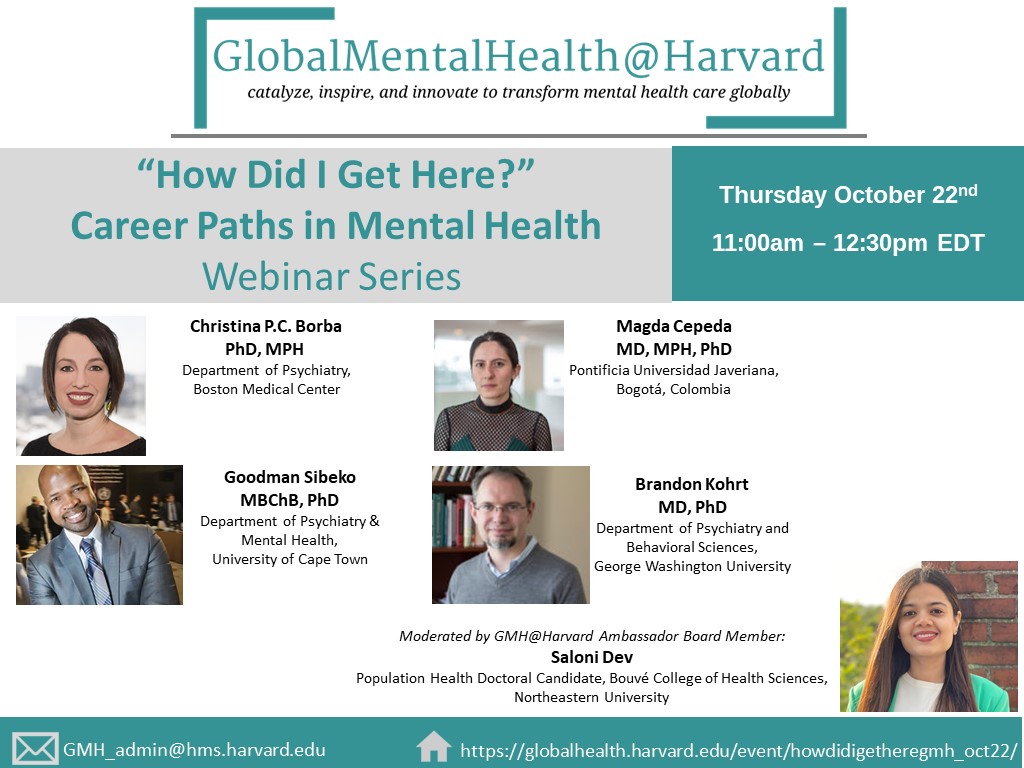
GMH@Harvard: “How Did I Get Here?” Career Paths in Mental Health Series

The purpose of the panel webinar series is to highlight and learn from the career paths of individuals who have been successful in diverse aspects of global mental health work. These seminars will seek to connect students and interested individuals to professionals in the field by understanding their career paths and how their passion and experiences led them to pursue a career in global mental health.
tech and health
tech and health

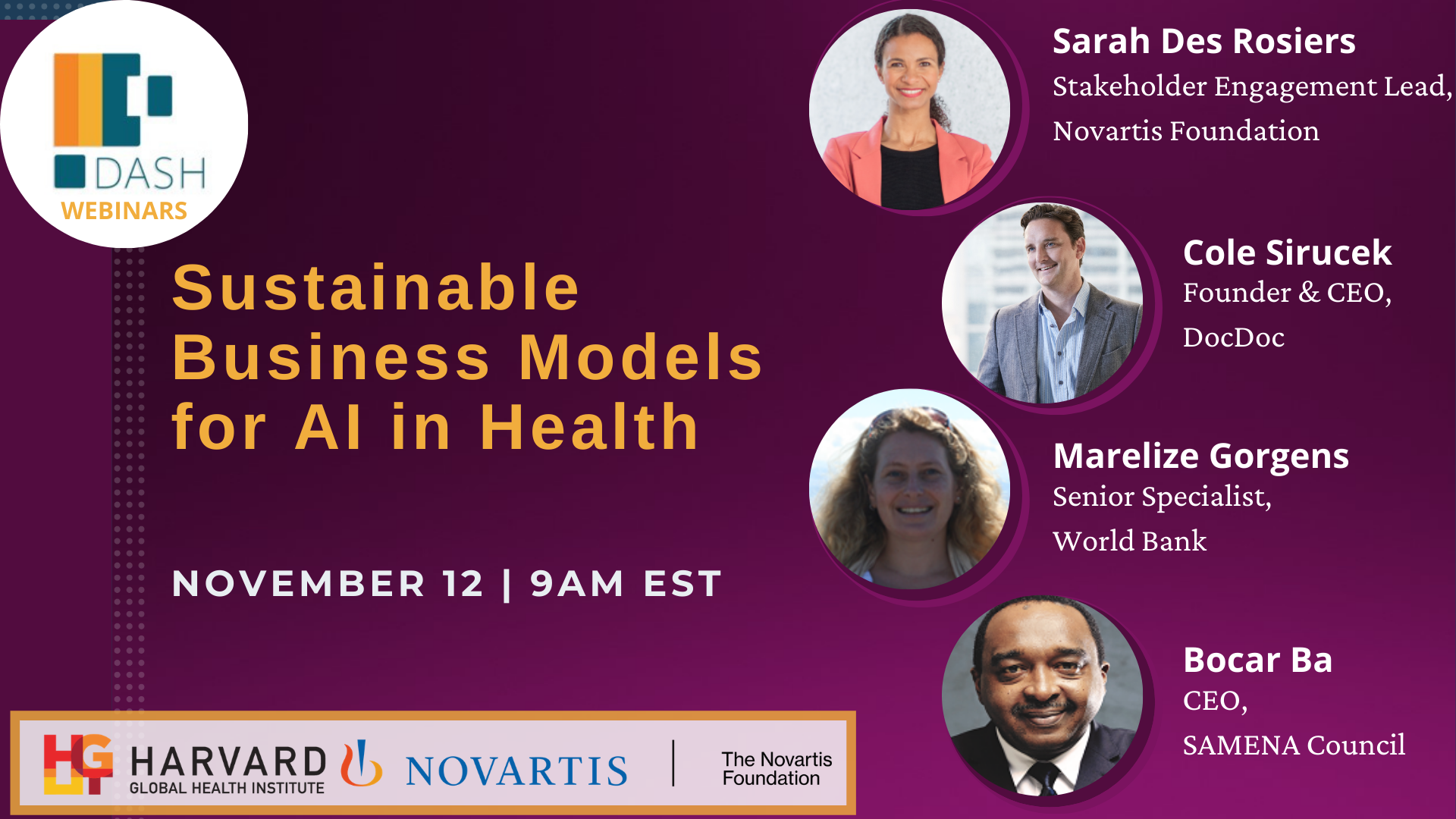
DASH Webinar: Sustainable Business Models for AI in Health

Virtual: Zoom
REGISTER HERE Digital health and AI tools have skyrocketed since the start of the COVID-19 pandemic. The potential is enormous –  yet the long term scalability and sustainability of these innovations remains unknown. As the digital health space propels forward, key questions remain on how we can create an environment where innovators thrive and governmental policies support sustainable business models. In this panel discussion, speakers will reflect on the types of partnerships and structures needed to ensure high-impact products reach those most in need, and tools which improve health outcomes continue to do so well beyond the pandemic. MODERATOR Sarah Des Rosiers Stakeholder Engagement Lead | Novartis Foundation Sarah Des Rosiers is a global health professional dedicated to use the power of innovation and partnerships to solve today’s health access challenges. In 2020, Sarah joined the Novartis Foundation to shape the outcome measurement work of its cardiovascular urban health initiatives and to build cardiovascular population health approaches in low-middle income countries that are driven by innovative health and care delivery. A former management consultant with PwC, she advised major healthcare players (pharma industry and global health organizations) on projects that focused on market access, management improvements and impact evaluation. Prior to this, she held roles at WHO, UNAIDS and the Clinton Health Access Initiative and built her expertise in program and grant management, focusing on strengthening health systems and increasing access to affordable services and medicines globally. Through all these roles, she worked closely with health authorities and partners in countries like Haiti, Tanzania and Cameroon. Sarah received an MSc in International Health Policy & Economics (LSE) and an MBA from the University of St. Gallen (HSG), Switzerland. She was born in Canada and lives with her family in Switzerland. PANELISTS Marelize Gorgens Senior Specialist | World Bank Marelize leads a global program on Decision and Delivery Science in Health and Human Development at the World Bank. The aim of this program is to accelerate the use of analytics and digital health innovation to improve human development outcomes in low and middle income countries. With an academic background in engineering, mathematical modelling, public health, and predictive analytics, her career started in management consulting, and then switched gears to international development — working first for the Government of Malawi and later for the World Bank. She has spent over 20 years working alongside Governments, the private sector and not-for-profit organizations in low and middle income countries improving the efficiency and effectiveness of health and education programs. She has been invited faculty at master’s degree courses at Universities. She has published extensively (both academically and technical books, some of which are used as teaching materials in universities), and is on the editorial board of two journals. Cole Sirucek Founder and CEO | DocDoc Cole Sirucek is an investor and entrepreneur with over 14 years of experience founding, investing into and otherwise supporting entrepreneurial ventures on a global basis. He has founded a diverse range of businesses in his career. Cole is a Co-Founder of DocDoc Pte. Ltd., which is Asia’s largest doctor discovery and appointment reservation system. He is also the Co-Founder of Epic MMA Club, Asia’s largest mixed martial arts training center. On the investment side, Cole is currently a Managing Director at Founders Equity Partners, a direct secondary investment fund. Cole spent seven years as a direct investor with Temasek Holdings. In this capacity, he sourced, executed and monitored investments on a global basis in the firm’s telecommunications, media and technology group. Before Temasek, he was the Co-Founder and Executive Vice President of Pluto Networks – a wireless data networking company. He has previously held executive positions in Hawaii’s State Government and has worked as a technology venture capitalist and strategy business consultant. Cole attended Massachusetts Institute of Technology, Sloan School of Management (Master of Business Administration) and Harvard’s Kennedy School of Government (Master in Public Administration). He was a President of MIT’s Private Equity & Venture Capital Association and a Lead Organizer of the MIT $100K Global Startup Workshop Entrepreneurship Competition. Bocar BA CEO | SAMENA Council Bocar BA is an advocacy specialist, focused on the promotion of sustainable digital development, ICT infrastructure expansion and investment through collaboration and multi-stakeholder partnerships in the Middle East and Africa regions. BA is the CEO and a board member of SAMENA Telecommunications Council, which serves as a sector-development partner to governments and the telecommunications industry toward jointly creating a sustainable ICT environment as the enabler of sustainable digital economy. In his capacity as CEO of SAMENA Council, BA helps bring together and builds alliances between digital ecosystem stakeholders, including regulators and other government bodies, to address critical technocentric, policy, and regulatory issues. His efforts have directly helped drive key regional initiatives, summits and roundtables in areas including affordable infrastructure, advanced digital services, data and privacy regulation, spectrum management, and industry fees and taxation. BA is a strong advocate of advancing socio-economic progress and contributing to the achievement of the UN’s Sustainable Development Goals (SDGs) through ecosystem-wide collaboration on proliferating ICTs, and setting incentives for investment in digitization and advanced communications infrastructure.

How COVID-19 Is Shaping The Digital Health Space

Virtual: Zoom
REGISTER HERE The COVID-19 pandemic has fundamentally altered health priorities around the world. Across all sectors, organizations are engaging with digital solutions to tackle the spread of the virus and relying on data to make critical decisions around healthcare delivery and resource prioritization. In this webinar, panelists will discuss why we are seeing an increase in the use of digital during the COVID-19 pandemic, and how this extreme experience has awakened the world to the crucial infrastructure that needs to be in place in order to rapidly respond to future health emergencies. MODERATOR Bruno Villetelle Head of Data and Digital Global Drug Development | Novartis Bruno joined Novartis in April 2019 and leads the Data and Digital function for the company’s Global Drug Development (GDD) organization. He drives GDD’s data and digital vision, strategy and governance, and is focused on embedding data science and digital technologies to enhance asset development. Bruno has more than 30 years of experience spearheading digital and technology led innovation and new business model creation in the pharmaceutical, consumer health, and service industries. Prior to joining Novartis, he worked for Takeda Pharmaceutical Company Limited, a global top 10 pharmaceutical company, where he was Chief Digital Officer and oversaw more than 40 digital lighthouse programs. He also led the development of a portfolio of digital health companies offering game-changing digital solutions for patients and drug development. Bruno has a Master of Science degree in Industrial Organization & Methodology and a Master of Science in Business Systems Management from the University of Lyon, France. He also has a Master of Engineering in Enterprise Information Systems from the Conservatoire des Arts et Métiers, France. In 2017, he was nominated one of the Top 40 healthcare transformers by MM&M (Medical, Marketing and Media). PANELISTS Maimuna (Maia) Majumder  Instructor | Boston Children’s Hospital & Harvard Medical School Dr. Maimuna (Maia) Majumder is a member of the ladder-rank faculty at the Computational Health Informatics Program (CHIP) based out of Harvard Medical School and Boston Children’s Hospital and a recent graduate of the Engineering Systems program at MIT’s Institute for Data, Systems, and Society (IDSS). In between her graduate studies and her current position at CHIP, Maia spent a year at the Health Policy Data Science lab at Harvard Medical School’s Health Care Policy department as a postdoctoral fellow. During her masters and doctoral studies at MIT, she was funded through a graduate fellowship at HealthMap computational epidemiology group. Prior to Maia’s arrival at MIT, she earned a Bachelors of Science in Engineering Science (with a concentration in Civil and Environmental Engineering) and a Masters of Public Health in Epidemiology and Biostatistics at Tufts University. While at Tufts, Maia was a field researcher with the International Centre for Diarrheal Disease Research, Bangladesh (ICDDR,B), where she worked with clinic patients (and their data) to learn how to better tell their stories. Her current research interests involve probabilistic modeling, data science, and “systems epidemiology” in the context of public health, with a focus on causal inference for infectious disease surveillance using digital disease data (e.g. search trends; news and social media). She also enjoys exploring novel techniques for data procurement, writing about data for the general public, and creating meaningful data visualizations. Helmi Zakariah, MD CEO | Artificial Intelligence in Medical Epidemiology (AIME) Dr Helmi Zakariah begins his journey with AIME as the Chief Operating Officer in Malaysia before being appointed as the Chief Executive Officer for AIME INC operation in the Asia-Pacific region effective from January 2nd, 2018. He currently oversees AIME’s operation, strategy and business development in Asia and the Pacific. Dr Helmi started off his career as a clinician in Seremban General Hospital and subsequently a community clinic in Selangor, before he embarked on Public Health as a district program manager for National Tuberculosis Control Programme. With an extensive background and experience in the field of Public Health, Dr Helmi was previously with Ministry of Health Malaysia where he co-pioneered the establishment of Global Health Division which strategizes, coordinate, and oversees Malaysia engagement with global health and strategic partnership with international NGO such as the WHO, MSF, ASEAN, South-South Cooperation Centre and the Union of International Cancer Control. He also has a special interest in Trade & Public Health, and was regularly consulted to analyze multilateral trade agreements and its impact on national health policy space. In 2014, he participated in the Joint United-Nations Initiative for Migration in Asia Steering Committee, for his academic and advocacy works in the area of migrant health. Dr Helmi Zakariah holds a Medical Degree from Russian Federation, and a Master in International Public Health from Liverpool, United Kingdom. He regularly shares his thoughts as speakers through global cooperative platforms such as Chatham House, WEF, and Commonwealth Digital Health Forum.
Global Mental Health

GMH@Harvard: “How Did I Get Here?” Career Paths in Global Mental Health Series – Research focus

The purpose of the panel webinar series is to highlight and learn from the career paths of individuals who have been successful in diverse aspects of global mental health work. These seminars will seek to connect students and interested individuals to professionals in the field by understanding their career paths and how their passion and experiences led them to pursue a career in global mental health. It also serves to encourage individuals to find their own path in the global mental health community.
Global Mental Health

World Mental Health Day: Global Mental Health Fest ’20

To celebrate the World Mental Health Day 2020, the World Federation for Mental Health In Association With GlobalMentalHealth@Harvard brings to you the Global Mental Health Fest'20, a 3-Day Virtual Festival featuring eminent speakers and artists from different countries.

Global Mental Health

GMH@Harvard:  Narratives of parentification from urban India: Lived experiences of childhood abuse and neglect, long term consequences and the way forward

A Mental Health Study Group organized event – Contact GMH@Harvard Ambassador Board Member Yuri Sugimoto for more information Presenter: Nivida Chandra is a doctoral research scholar at IIT Delhi. She studies the lived experience and long-term impact of emotional neglect of children in India, particularly parentification. She is also the founder-editor of TheShrinkingCouch.com, which hosts a collection of informational and experiential articles for those affected by mental health concerns.
Global Mental Health

GMH@Harvard: “How Did I Get Here?” Career Paths in Mental Health Series – Clinical focus

The purpose of the panel webinar series is to highlight and learn from the career paths of individuals who have been successful in diverse aspects of global mental health work. These seminars will seek to connect students and interested individuals to professionals in the field by understanding their career paths and how their passion and experiences led them to pursue a career in global mental health. It also serves to encourage individuals to find their own path in the global mental health community.
Global Mental Health

GMH@Harvard Feature Event: World Alzheimer’s Day Screening & Discussion with MOTHER filmmaker

Screening from 9-10:20am Discussion & Q&A from 10:20am-11am Join for all or part of the event! Join GMH@Harvard as we honor World Alzheimer’s Day on September 21st with a screening and discussion of the documentary MOTHER! Click here to register. MOTHER In a small village in Thailand, Pomm takes care of Europeans with dementia. Separated from her children, she helps Elisabeth during the final stages of her life, as a new patient arrives from Switzerland.   MOTHER is a moving observation of motherhood and care. View the trailer here. Following the screening join us for a discussion with filmmaker Kristof Bilsen moderated by Professor Arthur Kleinman, author of the Soul of Care. For more information visit: / Kristof Bilsen Kristof received his Masters in Documentary Direction at the National Film and Television School (UK). In 2014 he released Elephant’s Dream, a portrait of three state-owned institutions and their workers in DR Congo, a film he directed/filmed and co-produced. He is an IDFA Academy and EURODOC graduate and is one of the Emerging Producers for Jihlava 2019. He won several awards, such as Grand Prize Nanook-Jean Rouch in Paris, Magic Hour Award at Docs Against Gravity (Warsaw), the TRT 2nd International Documentary Award in Istanbul, Special Mention Bertha Best International Documentary at One World Media Awards (UK), the Buzz Wilson Award at Michael Moore’s Traverse City Film Festival, and his work screened at various festivals internationally. He regularly teaches and gives workshops on documentary research, storytelling and production. Kristof’s films include: MOTHER, 82′ / 2019 Elephant’s Dream, 75′ / 2014 The Perfect Belgian, 34′ / 2010 Parallel Lives, 34′ / 2010 Three Women, 50′ / 2005
Global Mental Health

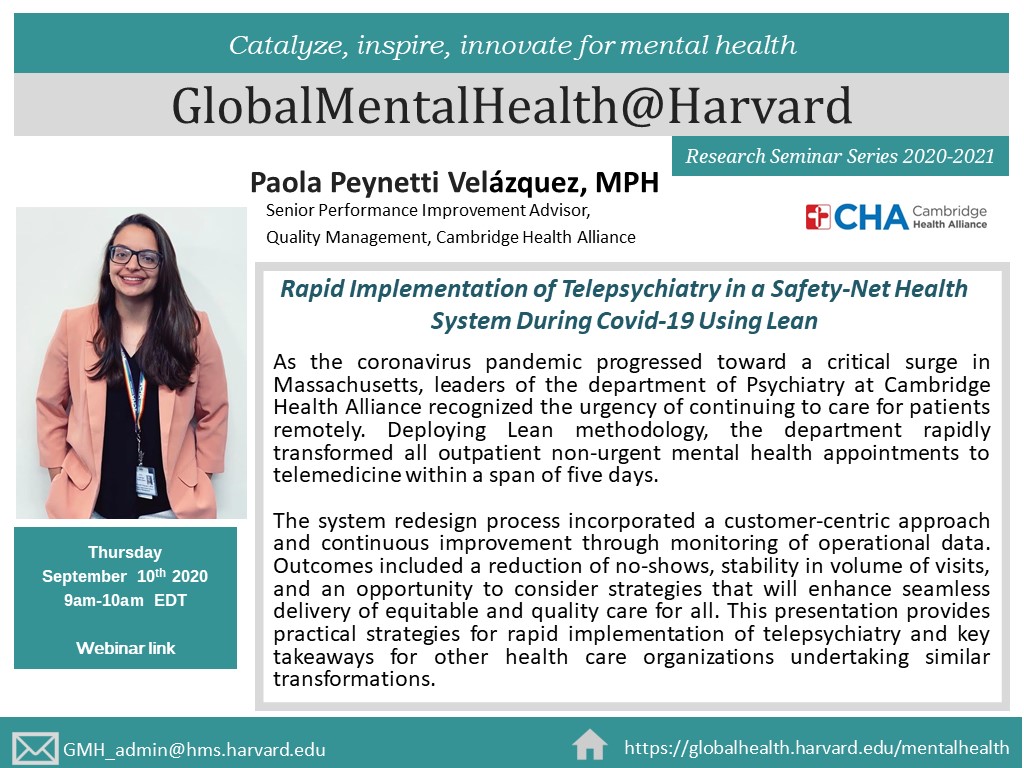
GMH@Harvard Webinar: Rapid Implementation of Telepsychiatry in a Safety-Net Health System During Covid-19 Using Lean

  Register here for zoom link! As the coronavirus pandemic progressed toward a critical surge in Massachusetts, leaders of the department of Psychiatry at Cambridge Health Alliance recognized the urgency of continuing to care for patients remotely. Deploying Lean methodology, the department rapidly transformed all outpatient non-urgent mental health appointments to telemedicine within a span of five days. The system redesign process incorporated a customer-centric approach and continuous improvement through monitoring of operational data. Outcomes included a reduction of no-shows, stability in volume of visits, and an opportunity to consider strategies that will enhance seamless delivery of equitable and quality care for all. This presentation provides practical strategies for rapid implementation of telepsychiatry and key takeaways for other health care organizations undertaking similar transformations. Speaker: Paola Peynetti Velázquez, MPH Sr. Performance Improvement Advisor, Quality and Safety, Cambridge Health Alliance Paola earned a BA in International Relations and Latin American Studies and an MPH in Global Health from Boston University. Her interests and focus in graduate school included participatory development, transparency, anti-corruption, ethics, and effective altruism. Originally from Mexico City, Paola joined the Performance Improvement team in the Quality & Safety department at Cambridge Health Alliance in March of 2017. In her role as Senior PI Advisor, she collaborates closely with senior leadership to plan, facilitate, and execute strategic, system-wide, lean projects to streamline hospital operations with the goal of improving access to care for patients across inpatient, emergency, and ambulatory care settings. Although she has worked with multiple clinical and non-clinical areas across the system, Paola´s focus at CHA has been to support to the Psychiatry department in redesigning dozens of processes to improve provider and staff engagement, reduce chances of error, eliminate waste, and meet CHA´s population health objectives as a safety net Accountable Care Organization.

Save the Date: Stakeholder Meeting — Global Diet Quality Score: A New Method to Collect and Analyze Data on Diet Quality

This remote stakeholder meeting will include a series of presentations to describe the work to develop and validate the GDQS, a new metric of diet quality appropriate for use in LMICs; and an opportunity for meeting participants to ask questions and provide feedback to help inform the next steps of the research, before the metric development and validation work is finalized. The meeting will also introduce participants to the method under development to facilitate the collection of GDQS in large-scale population-based surveys in LMICs. Registration information will be available soon. Please submit your email contact information here to receive forthcoming information about the event, and receive registration information when it is available. Questions about the event can be sent to feedback@intake.org. Up-to-date information about the event will also be available at intake.org. Meeting Speakers: Walter Willett, Harvard T.H. Chan School of Public Health Shilpa Bhupathiraju, Harvard T.H. Chan School of Public Health Sabri Bromage, Harvard T.H. Chan School of Public Health Megan Deitchler, Intake – Center for Dietary Assessment Mourad Moursi, Intake – Center for Dietary Assessment The GDQS research initiative was launched by Intake – Center for Dietary Assessment. The research is led by Harvard T.H. Chan School of Public Health, Department of Nutrition and carried out in collaboration with researchers at the National Public Health Institute (INSP), Mexico. Funding for the research is provided by FHI Solutions, recipient of a Bill & Melinda Gates Foundation grant to support Intake – Center for Dietary Assessment.