Finding Your Place in Global Health: Advice for the Next Generation of Professionals
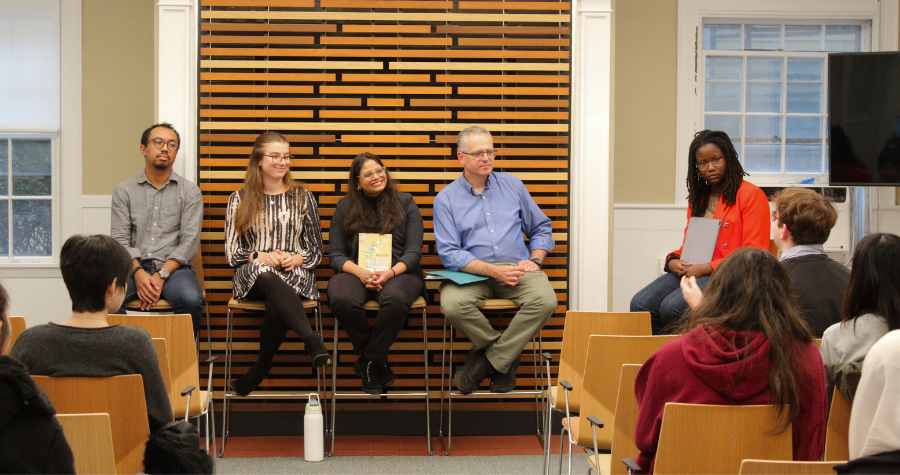
What does it take to build a career in global health? There is no single path, according to speakers at a recent panel co-hosted by the Harvard Global Health Institute (HGHI) and the Mignone Center for Career Success. Careers in Global Health: Pathways, Challenges, and Opportunities brought together four professionals working across research, clinical care, community partnerships, and nonprofit development to share their experiences and advice with Harvard undergraduate and graduate students.
Moderated by Emefa Dake, a Harvard College senior studying Economics and Global Health and Health Policy, the discussion explored how students can gain meaningful experience, develop practical skills, and navigate the opportunities and challenges of entering the field.
Panelists Himi Mathur, a DrPH candidate at Harvard T.H. Chan School of Public Health; Hervet Randriamady, a Postdoctoral Research Fellow at the Department of Nutrition at Harvard T.H. Chan School of Public Health; Joel Sawady, MD ’05, a primary care physician at Cambridge Health Alliance; and Cecilia Needham, a recent graduate of the Master of Medical Sciences in Global Health Delivery program and development manager at the Institute for Justice & Democracy in Haiti, offered perspectives shaped by their distinct career journeys.
Across their experiences, a common message emerged: building a career in global health takes more than technical expertise. It requires listening, adaptability, strong relationships, and a willingness to learn along the way.
Understanding the Context Behind the Work
For Hervet Randriamady, community engagement has been central to shaping his research. His work in Madagascar, where he studies the relationship between climate change and mental health, grew from sustained engagement with communities and an awareness of gaps in access to mental health care.
Rather than arriving with all the questions already defined, Randriamady described how conversations with local communities helped him identify research priorities and understand how people experienced and understood mental health. His work also connects environmental challenges, including food insecurity among fishing communities, with broader questions about health and well-being.
His advice to students was simple: “Be culturally sensitive.”
Joel Sawady, a primary care physician at Cambridge Health Alliance, echoed the importance of relationships through his longstanding collaboration with La Asociación de Campesinos para el Desarrollo Humano (CDH), a locally led organization in El Salvador focused on community health and rural development.
For Dr. Sawady, meaningful partnerships require time, trust, and sustained commitment. Students interested in global health should look for opportunities to learn directly from communities and organizations, rather than waiting until they have completed their training to put their knowledge into practice.
His advice: “Get yourself out there. Learn by doing.”
Looking Beyond Innovation to Impact
Global health careers are also being shaped by emerging technologies and complex health systems. Himi Mathur’s research on AI-enabled clinical decision support systems examines what it takes to integrate artificial intelligence responsibly into health care.
For Mathur, evaluating a technology means looking beyond whether it works. Students must also consider who owns it, who funds it, who can access it, and how it fits into the health systems in which it is used.
Mathur encouraged students to think carefully about how problems are defined and measured, particularly when working with complex concepts. Before deciding how to measure an issue, it is important to understand the system being studied and establish clear boundaries around the question.
For students exploring potential career paths, this means looking beyond familiar roles in medicine and public health. Technology governance, implementation, data analysis, and health systems research can all contribute to global health work.
Building a Career Across Disciplines
Panelists emphasized that every global health career involves conducting research or providing care directly. Cecilia Needham’s experience illustrates how skills in development, writing, and communications can support organizations working at the intersection of global health and human rights.
After completing her graduate degree in Global Health Delivery at Harvard, she moved into a development role at the Institute for Justice & Democracy in Haiti. She highlighted the importance of understanding how funding influences organizational priorities and how nonprofits communicate their work to potential supporters.
For students, grant writing and communication skills can open doors to opportunities they may not initially associate with global health.
Needham also emphasized that a first job does not have to determine the direction of an entire career. Experiences build on one another, and interests can change as students encounter new challenges and opportunities.
“Remind yourself often of your “why”. It will change over time and that is ok,” she advised.
Finding Your Own Way Forward
Across the discussion, panelists returned to the importance of taking a long-term view of a career. Global health work can be demanding, and meaningful progress often depends on sustained engagement rather than quick results.
Together, their perspectives offered a reminder that career development is not simply about accumulating credentials or finding the right first position. It is also about learning how to work with others, staying open to new directions, and finding an approach to work that can be sustained over time.
For students entering global health, there may be no predetermined path. But there are ways to begin building one.
Key Takeaways for Students
- Start by listening to communities. Effective research and programming begin with understanding local needs, perspectives, and priorities rather than assuming that one approach will work everywhere.
- Build relationships and trust over time. Authentic partnerships are essential to community-centered global health work and require sustained commitment, cultural sensitivity, and collaboration.
- Develop practical, transferable skills. Experience in research, data analysis, AI governance, grant writing, communications, and project implementation can support a wide range of career paths. Seek opportunities to build these skills through hands-on experience.
- Stay open to evolving career paths. A first job does not need to be the perfect fit. Students can develop new interests, explore different sectors, and build on experiences over time.
- Understand the systems that shape global health—and find your community. Technology, funding, institutional structures, and policy decisions influence which problems receive attention and how solutions are developed. Supportive relationships, personal motivation, and a sustainable approach to work are equally important for long-term engagement in the field.