


Careers in Global Health: Insights from the HGHI Panel
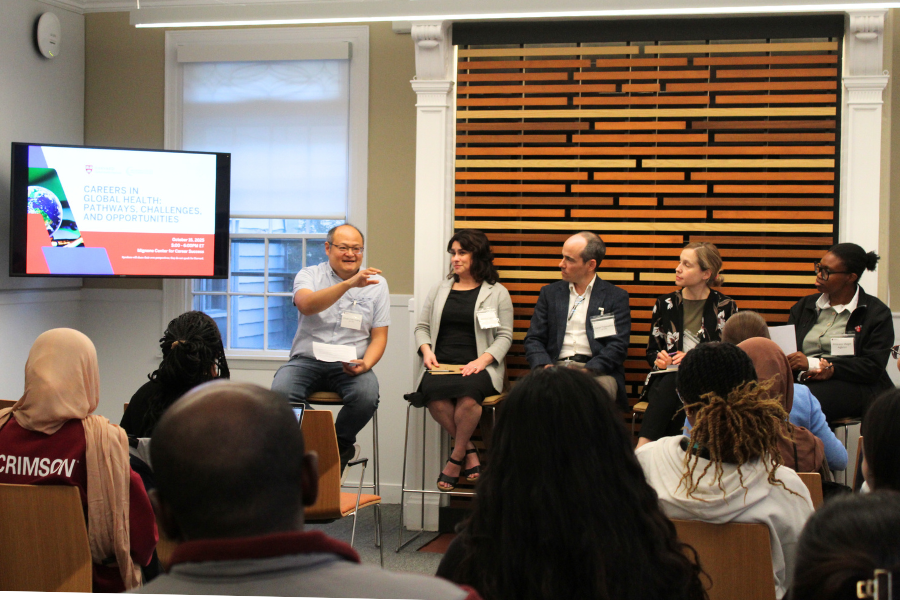
On October 15, the Harvard Global Health Institute (HGHI), in collaboration with the Mignone Center for Career Success, co-hosted a panel discussion on “Careers in Global Health: Pathways, Challenges, and Opportunities,” as part of Worldwide Week at Harvard. The event brought together over 40 Harvard undergraduate and graduate students to engage with leading experts from medicine, public health, and business on navigating careers in global health.
The panel featured Jessica Cohen, PhD, Professor of Health Economics at Harvard T.H. Chan School of Public Health; Daniel Palazuelos, MD, MPH, Assistant Professor of Medicine at Harvard Medical School and Director of Community-Centered Medical Education; Ashley V. Whillans, PhD, Volpert Family Associate Professor of Business Administration at Harvard Business School; and Chuan-Chin Huang, ScD, MSc, Associate Epidemiologist at Brigham and Women’s Hospital. The discussion was moderated by Princess Magor Agbozo, graduate student at Harvard T.H. Chan School of Public Health.
Finding Your Path: Openness and Adaptability
Panelists agreed that there is no single path to global health. Instead, success comes from remaining open to new opportunities and being willing to learn from unexpected experiences.
Jessica Cohen encouraged students to “take opportunities even if you don’t think they are right for your path,” emphasizing that exposure to how data is captured and how institutional decisions are made early on in your career can be transformative.
Chuan-Chin Huang echoed this, describing his own work as a constant process of learning alongside communities, not apart from them.
The Power of Relationships and Presence
Relationship-building emerged as a central theme as Ashley Whillans spoke about how collaboration and community insight are at the heart of meaningful change and research. She says that “the most effective teams in global health are those that value relationships as much as results. When people feel connected to a shared purpose, their capacity for impact expands.”
Daniel Palazuelos expanded on the importance of proximity, explaining that “you cannot advance relationships through virtual meetings or teaching from afar alone.” True partnership, he said, comes from showing up consistently and engaging directly in the work.
Confronting Challenges and Sustaining Commitment
During the Q&A, students asked how they could bridge research, policy, and advocacy, and what are some ways they could work effectively in politically or economically challenging environments. Panelists highlighted the importance of understanding systems, acknowledging structural barriers, and maintaining resilience. They noted that sustainable progress requires patience and long-term engagement, especially when working with vulnerable populations.
To learn more about our student opportunities and events at HGHI, please visit our Student Engagement Page.
About the Harvard Global Health Institute (HGHI)
The Harvard Global Health Institute (HGHI) is an interfaculty initiative that facilitates collaboration across the Harvard community and partners worldwide to advance global health equity. We tackle the greatest health challenges of our time through innovative transdisciplinary research, education, and partnerships that build knowledge and drive positive changes in global health.