


Curiosity, Music, and the Pursuit of a Healthier World: Anika Christensen’s Interdisciplinary Journey into Global Health
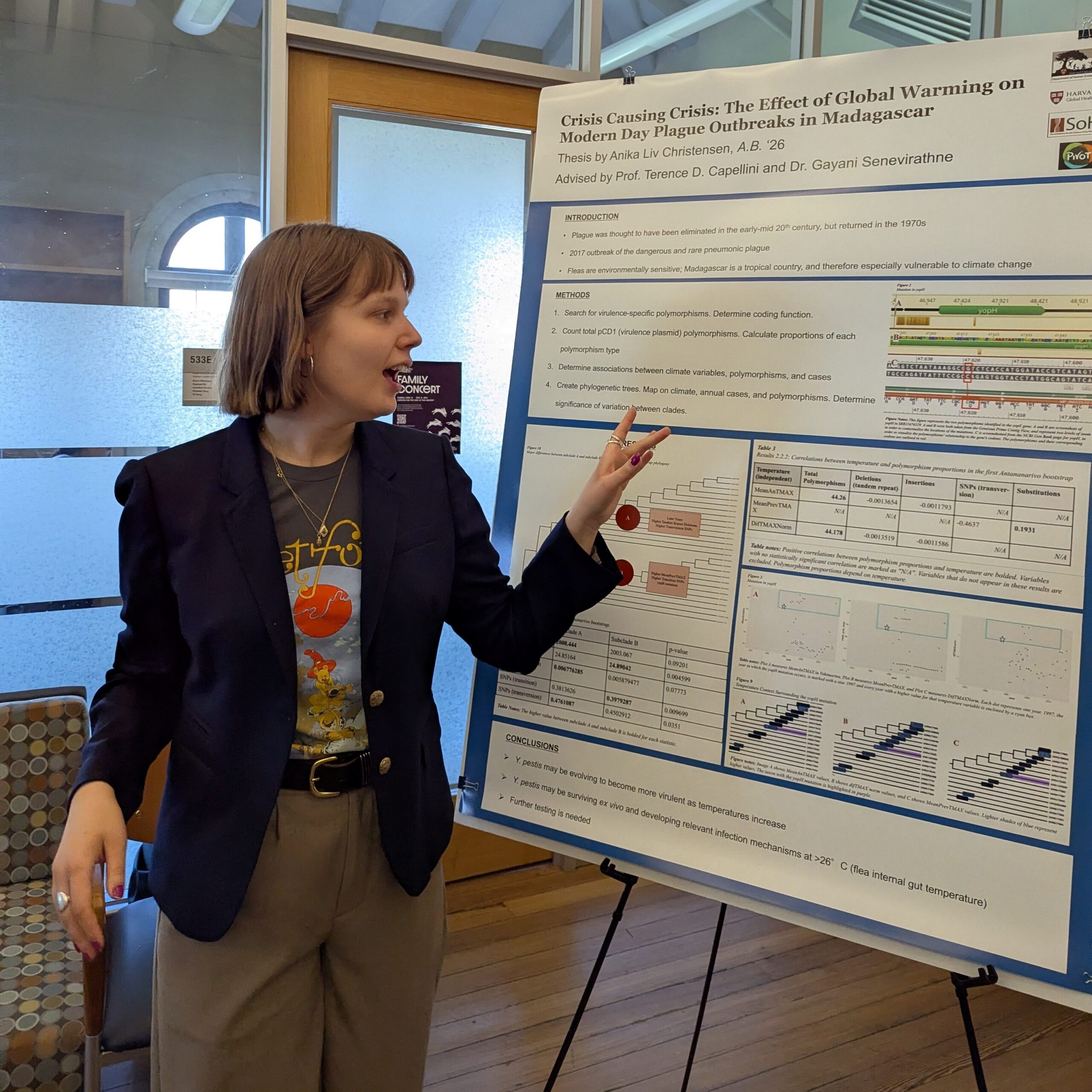

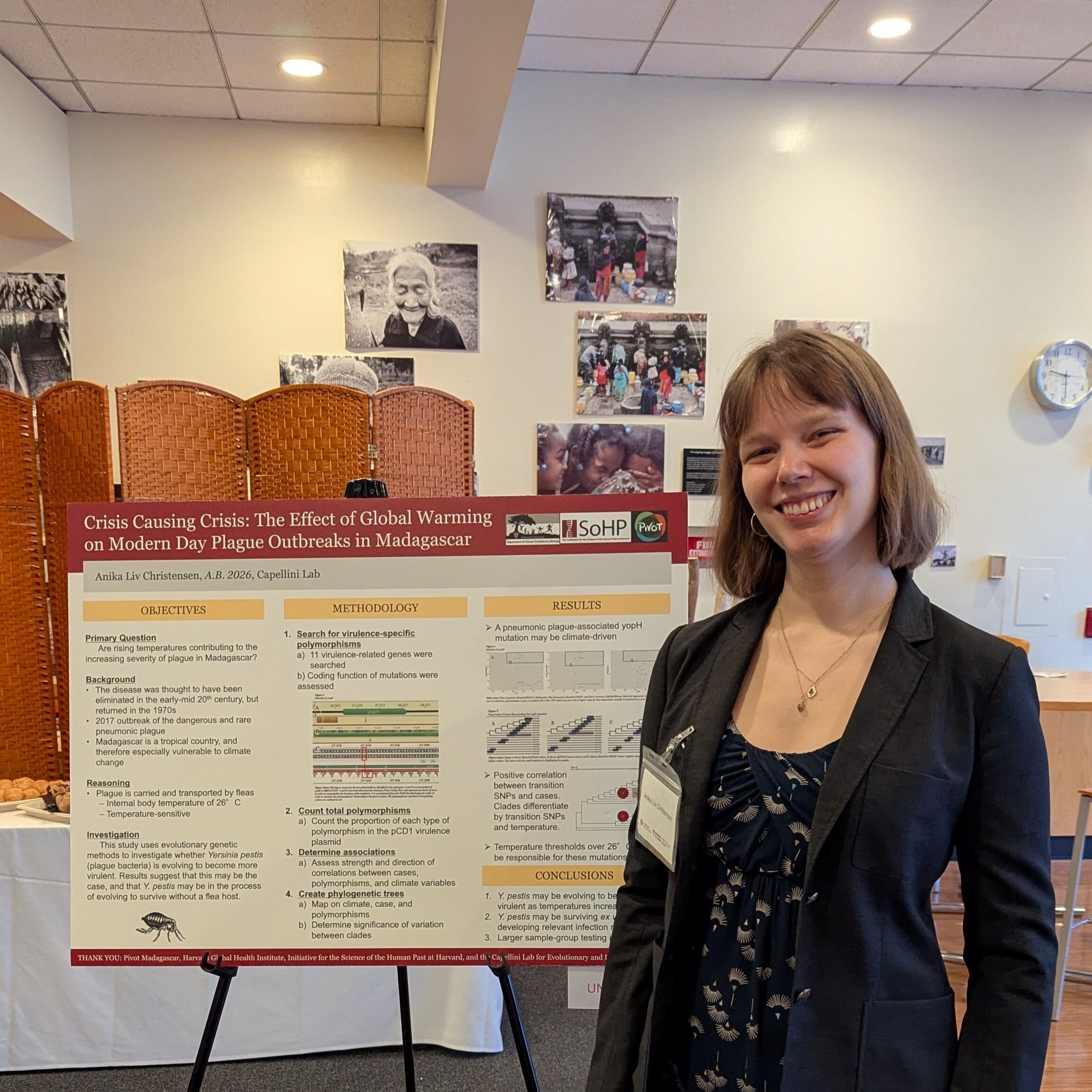
Recently named the undergraduate poster winner at the Harvard Global Health Institute’s (HGHI) 2026 Student Global Health Research Showcase, and a soon-to-be Fulbright Scholar heading to Germany this fall, Anika Christensen ’26 is poised to tackle some of the world’s most pressing health crises. But when she first arrived at Harvard, Christensen had never considered global health as a field of study or a possible career path.
The Pivot from Pre-Med to Public Impact
Like many ambitious high school students with an affinity for science, Anika arrived at Harvard on a traditional pre-med track. Coming from a rural town in upstate New York, she understood the standard blueprint for a career in science: go to college, go to medical school, and become a doctor.
However, after shadowing physicians a handful of times, she realized that the hospital environment wasn’t her true calling. Instead, she found herself deeply energized by the laboratory. Working in Harvard’s Human Evolutionary Biology (HEB) department, she discovered a passion for the meticulous and fascinating world of scientific research.
This realization prompted a profound guiding question that would shape her career trajectory: “I don’t want people to die of preventable diseases,” she recalls thinking. “How can I do that as a scientist as opposed to a physician?”
Discovering Global Health
Anika’s search for answers led her to explore the intersections of biology, history, and climate. She began researching the archaeology of the plague in Justinian France with the Science of the Human Past initiative. Around the same time, an eye-opening general education class on climate change, “Life and Death in the Anthropocene” with Dr. Naomi Oreskes, completely reframed her worldview. She realized her ultimate academic niche: the dangerous intersection of climate change and infectious disease.
Her faculty dean, Dr. Mercedes Becerra, an accomplished epidemiologist, helped connect these dots, introducing Anika to colleagues working on the plague in Madagascar. Through these experiences, global health emerged not just as a concept, but as a tangible career path.
This newfound direction led Anika to the Harvard Global Health Institute. In the summer of 2025, she participated in HGHI’s Summer Internship Program, an experience she credits with solidifying her future in the field.
Through HGHI, Anika was given the space and funding to conduct independent research for the first time. She focused on Madagascar, one of the few places in the world where the plague remains a persistent threat. By examining the country’s unique vulnerabilities—rising tropical temperatures that prevent flea die-offs, a heavily agricultural society, and fluctuating political systems that impact hospital funding—she began to map the complex web of global disease.
Beyond hard data, the HGHI internship provided Anika with a vital philosophical foundation. “I came into it not being a ‘global health person’ yet,” she explains. “Maybe the first week of the internship, we had this big lecture and conversation session on decolonizing global health. It gave me a much clearer perspective on the biggest issues in this field right now and what my responsibilities are as a researcher.”
HGHI offered a cohort of like-minded peers and intellectual spaces to discuss the ethical dimensions of the field. This immersive summer laid the groundwork for her senior thesis, ultimately leading to her award-winning presentation at the 2026 HGHI Student Global Health Research Showcase.
A Philosophy Without Borders
Today, Anika approaches global health with a fiercely interdisciplinary mindset. She strongly advocates that STEM students step outside their silos. “Biologists and pre-med people should be taking ethical philosophy, and most of them are not,” she says.
For Anika, global health is fundamentally about equity and erasing imaginary boundaries. “What makes it global health as opposed to just public health is that you’re taking away the issue of borders,” she notes. “A disease doesn’t need a visa to get across the border. I care about and value people and their health regardless of their nationality.” She views global health not merely as a scientific endeavor, but as an exercise in international relations, ethics, and historical responsibility.
Dual Quests: Science and Symphony
Remarkably, as her scientific career has flourished, Anika has never left her art behind. A double major in music, she sang with the Radcliffe Choral Society for all four years of her undergraduate career.
When agonizing over her post-graduate plans, she asked her Principal Investigator, Dr. Terence Capellini of Harvard’s Human Evolutionary Biology department, for advice on finding a scientific role that would still leave room for her “music side quest.” Capellini offered a paradigm-shifting response: “Is the music a side quest, or is it just a second main quest? You can be both of these things.”
This fall, Anika will perfectly marry these dual quests as a Fulbright researcher in the Department of Archaeogenetics at the Max Planck Institute for Evolutionary Anthropology in Leipzig, Germany, where she will work under the guidance of Dr. Alexander Herbig. At the institute, she will function in a highly collaborative environment alongside archaeologists, statisticians, and geneticists while developing advanced computational skills to analyze bacterial evolution.
Outside the lab, she looks forward to immersing herself in Leipzig, famously the city of Johann Sebastian Bach, where she hopes to connect with the local choral community, draw inspiration for her own compositions, and achieve cultural immersion through learning the German language.
Looking Ahead
Looking five years into the future, Anika envisions herself pursuing a PhD and eventually transitioning into a field-based research role with a major non-profit like UNICEF or the WHO. Her driving research question remains pressing: How is climate change exacerbating new epidemic and pandemic risks, particularly through zoonotic spillover (the transmission of pathogens from animals to humans), and what can we do about it?
From growing up in rural upstate New York—where she saw firsthand the impacts of tick-borne illnesses and agricultural runoff—to presenting award-winning research at Harvard, Anika’s trajectory proves that the best path into global health isn’t always the traditional one. By weaving together her passions for evolutionary biology, ethical philosophy, and music, Anika Christensen is preparing to make an impact on the world.