


Global Health Forward: Navigating Scarcity in a Fractured World Through Solidarity, Equity, and Shared Responsibility
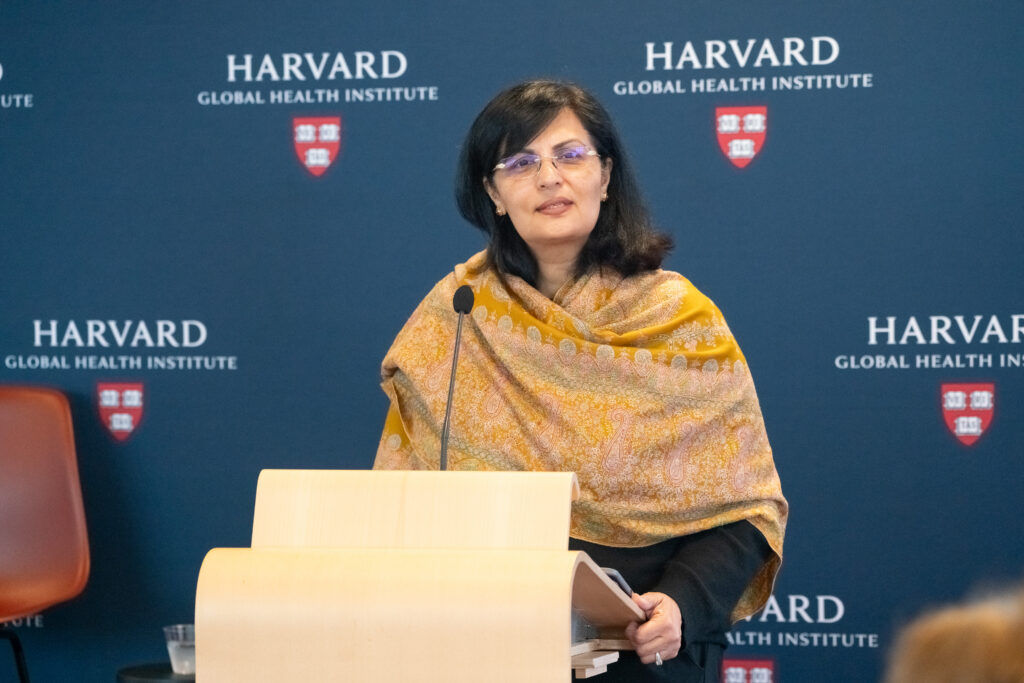
At the 2026 Global Health Symposium, hosted by the Harvard Global Health Institute (HGHI) on April 16, policymakers, practitioners, academics, and students gathered around a central idea: achieving global health equity in an age of scarcity requires moving from fragmented systems to shared responsibility.
Across sessions on multilateral architecture, emergency response, workforce training, and reforms in Africa and Latin America, speakers argued that today’s global health architecture is expensive, duplicative, and politically fragile—ill‑suited to a world of pandemics, climate shocks, and fiscal austerity. Progress will depend not only on new tools, but on institutional courage, political imagination, and genuine power‑sharing. As Louise C. Ivers, Faculty Director of HGHI, put it, progress demands honesty about what is failing, clarity on what must change, and collective action “not as a slogan but as a practice.”
Fragmented Architecture, Fragile Gains
Keynote speaker Sania Nishtar, CEO of Gavi, the Vaccine Alliance, traced global health’s evolution from tropical medicine to international health, primary care, product development partnerships, and today’s large multilateral organizations such as the Global Fund, Gavi, and PEPFAR. The gains have been enormous: a decade of added life expectancy, a 60% drop in under‑five mortality, and an estimated 75 million deaths averted through vaccination.
Yet early warning signs are emerging. Child mortality is creeping upward in some places, and the Organization for Economic Co-operation and Development has recorded the largest drop in official development assistance in decades. Nishtar warned this is not a short‑term fluctuation but a structural shift affecting many donor countries.
The fiscal squeeze exposes the weaknesses of an architecture in which health ministers must navigate dozens of agencies and initiatives—each with its own reporting and oversight requirements. The result, she argued, is “huge fragmentation” and administrative burden, especially for low‑ and middle‑income countries.
Nishtar called for reforms that align external funding with national priorities and consolidate and clarify mandates among global actors. She urged deliberate planning for the future of entities such as Gavi and the Global Fund so their strengths are preserved without fueling further proliferation. Diplomatic processes that produce only vague consensus statements after years of negotiation, she argued, are no longer adequate. Hard choices must be placed at the center of global health governance.
Priority Setting as a Political Act
The first panel translated these structural concerns into day-to-day reality. Addis Tamire of Amref Health Africa described how priority setting in many African countries is “less about rational evidence-based decisions and more about managing constraints imposed by donors and domestic politics.” External vertical programs, earmarked funds, limited fiscal space, and weak institutions result in “co-produced and fragmented” priorities.
Kalipso Chalkidou of the World Health Organization’s Performance, Financing and Delivery Department highlighted the macro‑fiscal picture. In many low‑income countries, out‑of‑pocket spending has grown faster than public health spending for 15 years, and domestic funding that rose during COVID‑19 has fallen back to 2010 levels. Several African governments now spend more servicing debt than on health and education combined. Without addressing international taxation, debt, and broader economic rules, she argued, debates focused only on specific interventions are incomplete.
From the donor side, John-Arne Røttingen, CEO of Wellcome Trust and co-author of the Lusaka Agenda, described the political challenges of shifting from powerful disease-specific programs to more flexible, systemoriented models. “Health is a political struggle,” he said. There is no functioning global political system, so progress hinges on domestic accountability, taxation reform, and efforts to curb illicit financial flows.
The panel advanced a concrete definition of solidarity: design and budget choices that prioritize the worst off, align with country‑led plans, and maximize value for each constrained dollar.
Emergencies as the New Normal
A fireside chat between Dick Chamla of the WHO Regional Office for Africa (AFRO) and Louise Ivers shifted attention from long‑term financing to emergency preparedness. Chamla noted that Africa faces 100–120 emergencies each year, from outbreaks to climate‑related disasters and conflict. During crises, priorities shift as health systems pivot to response.
Preparedness cannot be treated as an add‑on project, he emphasized. Many capacities mandated by the International Health Regulations—surveillance, laboratories, risk communication—are core health system functions. “You wouldn’t have strong preparedness if you do not have a stronger health system,” Chamla noted. Yet institutions often separate preparedness, response, and health systems into distinct silos.
WHO AFRO is investing in “emergency‑ready” primary health care and communities, complemented by digital tools. Chamla highlighted the Preparedness Data Exchange, an AI‑enabled dashboard that integrates epidemiological data, climate information, political alerts, and health system capacity indicators. The aim is to narrow the gap between alerts and decision‑making so ministries can understand complex risks and act early.
Still, Chamla stressed that technology cannot substitute for political will or community resilience. “Emergencies start and end in communities,” he said. Without community readiness, national plans fail.
Training for the Jobs That Actually Exist
Preparedness also implies a reliable pipeline of well-trained healthcare professionals. A panel on the future health workforce explored how to train people for real jobs in settings shaped by scarcity, migration, and rising chronic disease. Abebe Bekele of the University of Global Health Equity (UGHE) argued that many African countries lack a clear vision for the kind of doctors they need, often copying century‑old North American or European models.
At UGHE, students spend 6.5–7 years in a rural setting and graduate with both a medical degree and a Master’s in Global Health Delivery. The curriculum is designed backward from the job description of a rural district physician: a generalist who performs surgery and obstetrics, manages emergencies, and leads health teams. Young doctors often burn out in rural posts, Bekele argued, not because they lack commitment but because their training never prepared them for the breadth and responsibility of their roles.
Sriram Shamasunder, Professor of Medicine at the University of California San Francisco and Co‑Founder and Faculty Director of the HEAL Initiative, described HEAL’s interprofessional fellowship, which seeks to reimagine who is considered an “expert” and where learning occurs. US‑trained physicians share one full‑time equivalent position in underserved areas such as Navajo Nation or rural California; the savings fund salaries for local fellows—nurses, community health workers, and physicians in partner countries. Fellows in mixed cohorts train together in social medicine, structural competency, leadership, and advocacy while working full‑time in marginalized communities.
Shamasunder explained that community health workers often possess far deeper practical knowledge than urban-trained clinicians. Mixed cohorts, he suggested, “hold a mirror up” so local workers recognize themselves as leaders in the global health field.
Aparna Parikh, Professor at Harvard Medical School, highlighted oncology as a case study in the promise and pitfalls of global partnerships. Africa faces a rapidly increasing cancer burden but has limited oncology services and radiotherapy capacity. Her program co‑designs short, practical observerships with African institutions, emphasizing chemotherapy safety, tumor boards, and clinical trial management. The aim is to build durable networks and leadership among African oncologists without worsening local workforce shortages. Long‑term mentorship and sponsorship, not just brief training stints, are central.
Inequality, Law, and the Politics of Reform in Latin America
After a poetry reading by Evan Wang, a first‑year student at Harvard College and the 2025–2026 National Youth Poet Laureate of the United States, the afternoon turned to Latin America, a region marked by high inequality yet ambitious constitutional guarantees of the right to health.
Claudia Pescetto of Pan American Health Organization (PAHO), Regional Office for the Americas of WHO described Latin America’s characteristic “segmentation”: multiple financing and entitlement schemes for civil servants, social insurance members, the armed forces, police, prisoners, and the uninsured poor. Combined with under‑investment—public health spending averages about 3.8% of GDP, below the regional target of 6%—this produces patchwork coverage in which the poorest face growing out‑of‑pocket costs and financial hardship.
Former Peruvian Minister of Health Victor Zamora illustrated how this plays out in his country, which has at least six major health subsystems spread across 25 regions. Legal insurance coverage has expanded to roughly 98% of the population, including many Venezuelan migrants, but real access remains deeply unequal. “It’s one thing to have legal insurance,” he said, “but a very different story to have health care.”
Alejandro Gaviria, Former Colombian Minister of Health and Social Protection, recounted Colombia’s experience, which he called “the cost of success.” Reforms in the 1990s, rooted in solidarity and equal benefits, expanded coverage and significantly reduced out-of-pocket spending. But technological pressures, constitutional rulings, and statutory law made explicit priority setting difficult. Courts, often responding to middle-class plaintiffs with legal representation, broadened benefit packages and restricted the use of cost-effectiveness criteria. It has become impossible to reject new medicines solely on price grounds, he explained, even as the system’s deficit has grown to about 1% of GDP.
Health reform has thus become a flashpoint in wider ideological conflicts. Yet Gaviria remains cautiously optimistic, citing tools such as price regulation, compulsory licensing, and ongoing efforts among academics, medical associations, and the Constitutional Court to forge a more legitimate framework for saying “no” in a health system that cannot fund every demand.
Reflecting on Peru’s experience during COVID‑19—with five health ministers, three presidents, two congresses, and some of the world’s highest excess mortality—Zamora argued for “more state, not necessarily a bigger state but a responsible one.” That, he said, means stronger evidence‑based decision‑making, ethics in public policy, and a sustained commitment to those consistently left last in line.
Global Health Forward
Across regions and topics, the symposium converged on a shared conclusion: in a world of tightening resources and multiplying crises, global health can no longer afford fragmentation. Equity will depend on re‑designed institutions, honest priority setting, and a deeper practice of solidarity grounded in shared responsibility and attention to those most at risk.