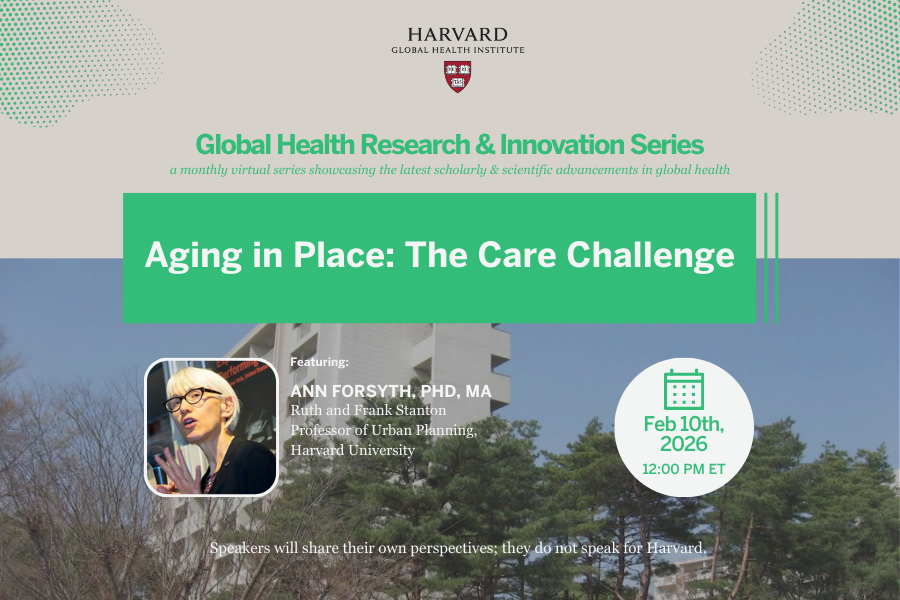
RECORDING: Aging in Place: The Care Challenge
In this talk, Professor Ann Forsyth explores how the built environment can support older adults who wish to remain in their homes and communities as they age.




Extreme heat is no longer a future climate concern; it is a public health crisis affecting communities around the world. While thousands convened in London for Climate Action Week, one of the year’s largest climate gatherings, Western Europe was simultaneously experiencing its most severe heatwave on record. Once viewed largely as a challenge concentrated in the Global South, rising temperatures are now reshaping daily life across Europe, the United States, and beyond, confirming extreme heat as a global crisis already affecting workers worldwide. According to the International Labour Organization, nearly 2.4 billion people, almost 70% of the global workforce, are exposed to excessive heat, contributing to an estimated 22 million non-fatal injuries and roughly 20,000 deaths each year.
At a recent Harvard Learn, Engage, Advance, Disrupt (LEAD) Fellowship alumni workshop, 12 fellows from 10 countries across Africa, Asia, Europe, and South America joined Satchit Balsari, HGHI Steering Committee Member and Associate Professor in Emergency Medicine at Harvard Medical School and Beth Israel Deaconess Medical Center, and in the Department of Global Health and Population at the Harvard T.H. Chan School of Public Health to examine what global health leaders should do differently as heat becomes an increasingly complex public health challenge.
Understanding heat requires more than measuring temperature. This distinction is particularly important for workers whose livelihoods depend on their ability to work through extreme temperatures. As Balsari explained, heat is not simply an environmental hazard; it is experienced through the realities of people’s work, homes, and daily lives. “If they cannot work under the heat, they cannot make money,” he said, revealing how rising temperatures force many workers to choose between protecting their health and earning a living. The challenge, he argued, is that many of the ways we currently measure and respond to heat fail to capture these lived realities.
Grounded in his work with the Self-Employed Women’s Association (SEWA) in India, Balsari showed how working alongside communities exposed important gaps in traditional approaches to climate and health. He noted that existing temperature measurements and weather station data often overlook the diversity of lived environments, from informal workers spending long hours outdoors to homes with limited ventilation, where heat exposure can vary dramatically even within the same neighborhood.
The group reflected on what these findings mean for policy and practice. 2021 LEAD Fellow Alice Kayongo Mutebi, current Senior Associate with the Center for Global Health Policy & Politics at Georgetown University, emphasized the importance of reframing how heat is understood in policy spaces. “I am looking at this data as information that can help us inform the reframing of heat, taking it out of public health alone and bringing it into labor and fiscal conversations so it is properly reflected in policy. If we reframe it this way, employers and policymakers may begin to see heat not as an abstract health issue, but as something that directly shapes work, productivity, and economic protection.”
Stela Bivol, 2019 LEAD Fellow and Regional Adviser for HIV, Viral Hepatitis, Sexually Transmitted Infections, Pandemic Threats, Communicable Diseases, and Antimicrobial Resistance, Health Security Division, WHO Europe noted that climate-related health pressures are increasingly straining existing systems. “We are at a critical juncture. The integration between emergency response and environmental health response is currently evolving, with active discussions shaping a more coordinated system. While cross-sector preparedness and adaptation work are underway, there’s a need to continue to refine and clearly define our joint operational response frameworks.”
This reframing shifts heat from being viewed solely as an environmental exposure or health outcome and positions it as a challenge affecting labor protections, economic stability, and social systems. The most effective solutions emerge when communities are not simply recipients of interventions, but partners in defining the problems, generating evidence, and shaping responses.
2019 LEAD Fellow Sai Subhasree Raghavan, Managing Trustee, SAATHII, identified social protection as a critical next step in protecting workers from extreme heat, pointing to existing models such as pensions and programs for widows and people living with HIV as examples of how governments can support vulnerable populations. “Ultimately, I’m sure we have all realized that it is not one department, but we have to bring various departments together,” she reflected. “Once the results are taken by the community to the various authorities… there is money already there, which can lead to innovation and adaptation measures at a large scale.”
Addressing extreme heat will require more than new technologies or isolated interventions. Effective adaptation depends on connecting health, labor, housing, and government systems, while ensuring that communities experiencing heat firsthand help shape the solutions.
Heat & Worker Safety: 12 Common Myths & What the Evidence Actually Shows
In this talk, Professor Ann Forsyth explores how the built environment can support older adults who wish to remain in their homes and communities as they age.
This panel explores how nations are advancing local vaccine manufacturing to accelerate health equity, offering insights into what national ownership looks like for vaccine development and distribution today, especially as traditional donor support declines.
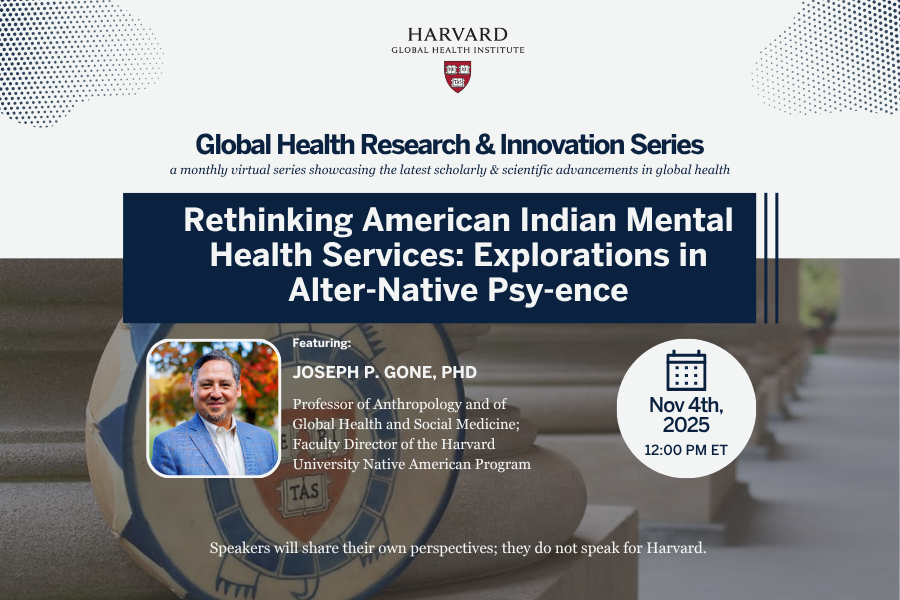
In this talk, Professor Joseph P. Gone explores how Indigenous perspectives can reshape understandings of mental health, challenging Western psychiatric frameworks and reframing “mental health” concerns as postcolonial disorders.