


Reimagining Mental Health Through Indigenous Worldviews
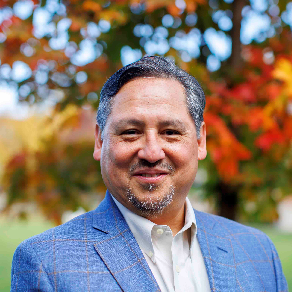
According to the Indian Health Service, the rates of alcohol, substance use, and mental health disorders in indigenous populations are disproportionately higher than the rest of the U.S. Although awareness of the problem has increased over the last 30 years, mental health services in native communities remain underfunded. Another challenge to the problem is that the traditional neo-liberal individualism approach to mental health care fails to address the unique cultural factors affecting these communities. In his talk, “Rethinking American Indian Mental Health Services: Explorations in Alter-Native Psy-ence,” Professor Joseph P. Gone, Professor of Global Health and Social Medicine at Harvard University, invited attendees to reconsider what mental health means when viewed through Indigenous knowledge systems rather than solely Western clinical models.
Since the early stages of his career, Gone has been examining depression and problem drinking within his own community on the Fort Belknap Indian Reservation in Montana. During this work, he interviewed a cultural traditionalist named Traveling Thunder, who linked substance abuse challenges to the historical and ongoing impacts of Euro-American colonization on community life.
Drawing from decades of collaborative work with tribal communities, Gone proposed an alternative Indigenous mental health discourse that contests and recasts mainstream psychiatric concepts and reframes “mental health” problems as postcolonial disorders.
“Modernity has presented humanity with a loss of identity and belonging. Figuring out how to rebuild community and reimagine tradition may be key to the well-being of modern humanity.” The solution lies in this alternative framework he calls an “alter-Native psy-ence”, which seeks to decolonize psychology by centering culture, history, and spirituality as integral to healing.
Q&A with Professor Gone
Professor Gone elaborated on what this alternative mental health discourse meant, and how we could use this approach to improve the well-being of indigenous communities.
Question 1: Reframing Cultural Understanding in Mental Health Practice
Question (Vikram Patel):
What are your thoughts about whether and how to educate mental health professionals about the diverse explanatory models and culturally rooted therapies that are meaningful to indigenous communities and so many others?
Answer (Joseph P. Gone):
Mental health professionals routinely receive orientation and instruction to diversity considerations through course content centered on cultural humility, cultural competence, or structural competence. Conventional approaches to this work often emphasize cursory demographic info (such as census categories) as proxies for diverse cultural orientations and practices. Unfortunately, these approaches are usually inadequate to account for the complexity and nuance of cultural variations in the experience and expression of distress or the plurality of potentially therapeutic practices. At best, they oversimplify; at worst, they stereotype. Instead, we should promote a basic anthropological overview of culture, variation, and human difference that is centered on constellations of shared meanings and practices that afford adaptive problem-solving by individuals in real world contexts.
Question 2: Example of a Culturally Appropriate or Integrated Program
Question (Vikram Patel):
In all your travels and explorations, can you share with us an example of a program that has successfully been able either to integrate or to provide culturally appropriate mental health services, with some success, to Native American communities?
Answer (Joseph P. Gone):
This does depend a bit upon how you want to define success and what criteria you have for evaluating that success. Let’s just say there have been very few randomized controlled trials of any treatment with any Native population in the mental health domain, less than a dozen. They’ve rarely replicated, and they typically have small sample sizes.
So, if your criterion for success is an RCT, there’s not going to be an answer for that. However, Native people offer plentiful answers about what’s helpful, what works, and what’s useful. And certainly, everywhere you go in Indian Country, there are people who have come out of addiction and substance abuse and who attribute their recovery to turning to traditional practices and spirituality.
One program I was privileged to be involved in was with the Detroit Urban Indian Health Clinic. We worked together to figure out how to package traditional practices and healing into the health services they offered for their urban Indian clientele. What we came up with was a traditional spirituality curriculum to help Indian people in urban environments—who had been cut off from traditional practices learn how to pray, how to participate in sweat lodges, and what those things mean.
So that’s an example of a program designed to harness traditional spirituality for therapeutic benefit. Now, does it ‘work’? Well, to prove that by Western standards, you’d need replication, larger sample sizes, and rigorous cause-and-effect evidence. But from a community perspective, it was meaningful, and as we often say, ‘Our culture is our treatment.’
Question 3: Relevance Beyond Indigenous or Minoritized Populations
Question (Vikram Patel):
As you know, there is a crisis of mental health care around the world. This is not only true of Native American people, but also of the mainstream U.S. population, where despite all the money spent on mental health science, every single population-level metric has worsened in the past two decades.
I wondered whether your idea of an ‘alternative psy-ence’ might have relevance not just to minoritized populations but also to the majority. What are your thoughts on that?
Answer (Joseph P. Gone):
Yes, I think there’s something to that. What Traveling Thunder identified as anomie, a loss of identity, belonging, and purpose is not limited to Native communities. Modernity has presented humanity with that condition for more than a century, where it becomes each person’s responsibility to create meaning and figure out how to live in the absence of shared narratives about what a good life looks like.
So, all of humanity is confronting this need to make meaning, especially as communal and cultural life erodes and individualism expands. I think rebuilding community, reimagining tradition for the modern moment, and restoring shared cultural life can be very beneficial for human well-being. That’s a lesson from Indian Country, and while it may look different in other contexts, it shows one way that healing can be done.
Event Recording & Resources

For additional insights, explore Professor Gone’s published work featured below.
- Reconciling evidence-based practice and cultural competence in mental health services: Introduction to a special issue
- Advancing Cultural-Clinical Psychology: Reflections on the Special Issue
- Four Principles for Cultivating Alternate Cultural Paradigms in Psychology: Summary Reflections on Innovative Contributions