Access to Oncology Medicines in Resource-Challenged Countries Requires Multi-Pronged Approach
Members of the HGHI Scholarly Working Group, Keith Flaherty (first from left), Aparna Parikh (second from left), and Clifford Samuel (first from right), at a panel at the BIO Convention in Boston in June 2025.
Cancer is the second leading cause of death worldwide, according to the American Cancer Society. In 2020, approximately 20 million new cancer cases were diagnosed, and 9.7 million people died from the disease globally. While 90% of people in high-income countries have access to comprehensive cancer care, 75% of patients in resource-challenged countries (RCCs) lack access to any diagnosis and treatment, resulting in disproportionately low survival rates in these countries. Supported by the Harvard Global Health Institute, the Scholarly Working Group “Access to Cancer Therapeutics” proposed that RCCs should collaborate with various stakeholders to make the latest oncology medicines more accessible.
“It takes a village to solve the problem of limited access to innovative oncology medicines in RCCs,” said Aparna Parikh, Associate Professor of Medicine at Harvard Medical School and Faculty Lead of the Scholarly Working Group. “The complex challenges to this problem will require all stakeholders, including pharmaceutical companies, local governments, and civil society, to adapt and collaborate to create an environment that would benefit all parties involved.”
Over the past year, the Scholarly Working Group partnered with former pharmaceutical executives and conducted a series of listening sessions to gain insight into how pharmaceutical companies approach access to oncology treatment options in RCCs.
“Much of the debate in global public health circles and in the research community places the bulk of the blame (and the burden to solve) on industry for the lack of access in RCCs, when in fact a holistic and collaborative approach is required, with critical roles for each player across the full spectrum of stakeholders in this arena. This is the tried-and-true solution to an improved outcome,” said Claudio Lilienfeld, former Senior Director at Gilead Sciences.
Lessons from the HIV Response: A Multi-stakeholder Approach
In a recently published white paper, the group outlines how the multi-stakeholder global response to HIV can be a model for improved patient outcomes and access to oncology medicines in RCCs.
Advocates, activists, donor governments, multilateral organizations, and RCCs all adapted to facilitate and expedite the HIV response, including mobilizing action, raising disease awareness, and improving health capacity.
Pharma companies also adapted their business models to meet the HIV challenge. The voluntary licensing model used extensively by Gilead, for example, not only became the path through which millions of patients and global aid funders achieved access to affordable life-saving anti-retrovirals, but also generated revenues for the company through low-margin/high-volume strategies, which kept the company’s access to medicines business unit profitable.
New Business Models for New Business Opportunities
By definition, RCCs are low economic performers. However, many of these countries have experienced significant economic growth over the last two decades. Pharma companies that are willing to adopt new strategies such as voluntary licensing, alternate brands, and tiered or variable pricing, have found sustained business success.
On a panel at the Bio Convention 2025 in Boston in June, members from the Scholarly Working Group addressed the hurdles pharma innovators face in dealing with the complexity of doing business in RCCs.
The BIO Convention was an opportune moment for convening discussions on access to drugs in LMICs because it brings together global leaders across biotechnology, policy, and healthcare, creating a unique platform to align innovation with strategies that expand equitable access to life-saving cancer medicines. Each of the panelists brought their own perspective to this important conversation.
A Universal Social Contract for a Sustainable Healthcare Ecosystem
The challenge of access and affordability of oncology medicines in RCCs requires cooperation and collaboration among all stakeholders. If everyone in the healthcare ecosystem in RCCs – governments, pharma companies, and the global health community – works together and commits to a universal social contract, a future where cancer patients, regardless of where they live or their economic means, can access the latest oncology medicines will not be too far off.
HGHI Scholarly Working Groups
The Harvard Global Health Institute’s Scholarly Working Groups are designed to encourage a collaborative environment, promote inter-faculty gatherings, and explore and accelerate research areas in topics critical to advancing “Health for All”. Each Scholarly Working Group includes faculty from at least two schools across Harvard University. Through these working groups, we aim to catalyze ideas, inspire the writing of grants, policy briefs, or working papers, or build networks to advance a program of work.
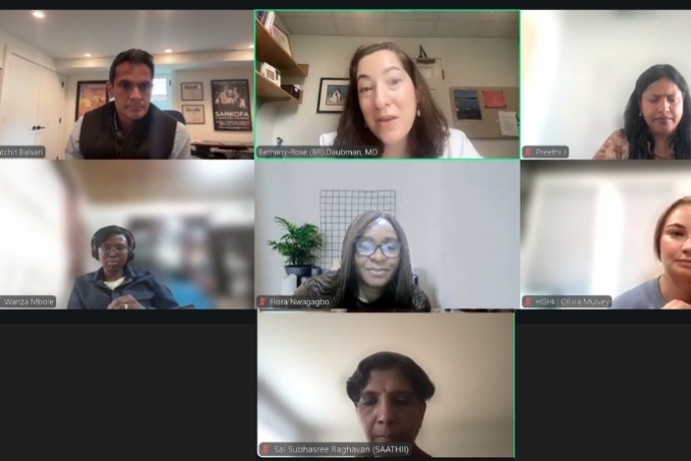
At a recent Harvard LEAD Fellowship alumni workshop, 12 fellows from 10 countries explored with Satchit Balsari how global health leaders can address the growing public health challenge of heat.
In this talk, Professor Ann Forsyth explores how the built environment can support older adults who wish to remain in their homes and communities as they age.
This panel explores how nations are advancing local vaccine manufacturing to accelerate health equity, offering insights into what national ownership looks like for vaccine development and distribution today, especially as traditional donor support declines.