How New Diagnostics and Surveillance Could Shape the Fight Against Drug-Resistant Gonorrhea
Antimicrobial resistance is widely recognized as one of the most urgent and fast-moving threats in global public health. The World Health Organization has identified bacterial antimicrobial resistance (AMR) as a major global health challenge, with drug-resistant infections already contributing to more than 1 million deaths worldwide each year. While resistance affects many pathogens, gonorrhea has become one of the clearest examples of how quickly bacteria can adapt to repeated antibiotic exposure and outpace available treatments.
Neisseria gonorrhoeae, the bacterium that causes gonorrhea, remains one of the most common bacterial sexually transmitted infections globally, with an estimated 80 million new infections annually. Over the past several decades, it has developed resistance to nearly every major class of antibiotics used against it, including penicillin, tetracyclines, macrolides, and fluoroquinolones. In some regions, reduced susceptibility to ceftriaxone, the current backbone of recommended treatment, has also been reported, raising concern about the long-term durability of remaining therapies.
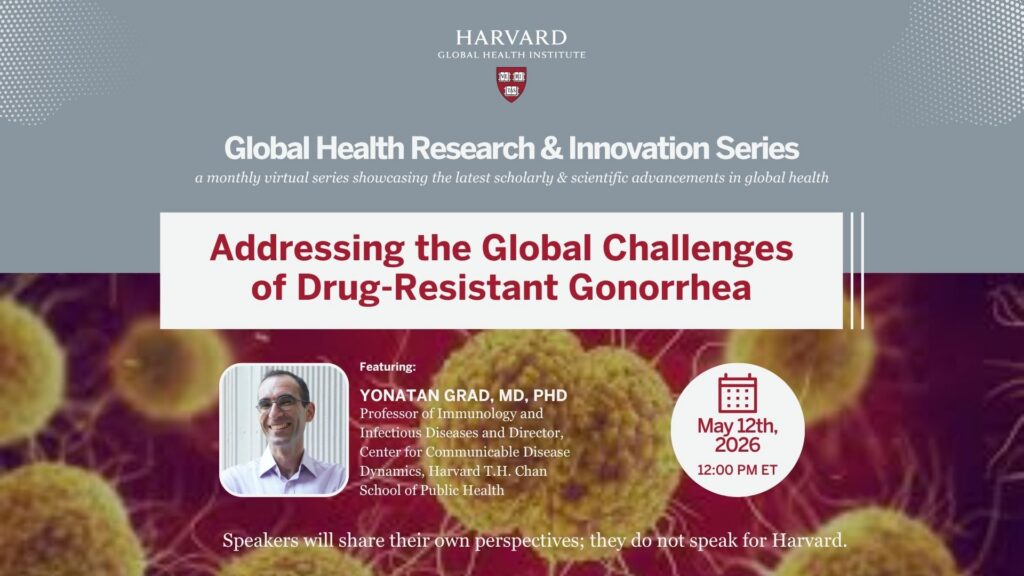
Below, Yonatan Grad, physician-scientist and infectious disease epidemiologist and Harvard T.H. Chan School of Public Health, Professor of Immunology and Infectious Diseases, and Director of the Center for Communicable Disease Dynamics, discusses how drug-resistant gonorrhea reflects broader challenges in antimicrobial resistance. In the recent Research & Innovation talk, “Addressing the Global Challenges of Drug-Resistant Gonorrhea”, moderated by Dr. Louise Ivers, Faculty Director of the Harvard Global Health Institute, Grad examined how increasing resistance in Neisseria gonorrhoeae is reshaping approaches to treatment, prevention, and surveillance, and emphasized that the challenge is not only developing new tools, but ensuring they are deployed in ways that preserve long-term effectiveness.
HGHI: What are the major barriers to implementing diagnostics that can both identify gonorrhea and guide antibiotic selection in real-world clinical settings?
Prof. Grad: We may have to wait a bit to see diagnostics that can both identify a pathogen and report drug susceptibility quickly enough to be useful clinically.
There is data that allows us to predict susceptibility to ciprofloxacin from pathogen DNA sequence. For example, if the gyrA codon 91 position is serine, the pathogen is susceptible, and if it’s phenylalanine, it is resistant.
Technologies to test for this variant through PCR and related methods exist, but so far they’re too slow for point-of-care testing.
In much of the world, management of sexually transmitted infections is syndromic. We don’t have access to point-of-care diagnostics that we would like to have access to diagnostics that can give us rapid information both on what pathogen is causing the symptoms and ideally information on what drugs it might be susceptible to.
This is the kind of information we often get in treating people with urinary tract infections, for example, easy diagnostics and rapid information on drug susceptibility. But it is very hard to get. We don’t have the tools for it yet for STIs.
So in most of the world, treatment really is syndromic. As diagnostics are developed, and there is a huge interest in this field and a lot of investment, with many startups and established companies trying to make these tools, those diagnostics will eventually allow point-of-care diagnosis and treatment.
As those tools become available, they will help inform both better surveillance and better treatment of individual patients with tailored therapy, but I think that is still a ways off right now.
If such diagnostics do become available, I think cost will also be central. What will be the cost-effectiveness argument for paying for and using such diagnostics instead of maintaining current syndromic management?
HGHI: How are you thinking about the balance between the clinical benefits of DoxyPEP and the potential risks of accelerating antimicrobial resistance?
Prof. Grad: DoxyPEP works well to prevent syphilis and chlamydia, and I would say one of its main goals really is to prevent syphilis. The increasing rates of congenital syphilis are a total tragedy and preventable. Syphilis is still curable, both with penicillin and doxycycline, so reducing rates of syphilis is an important public health and clinical goal, and this is a tool that can help us do that.
But it comes with a cost, and that cost is selecting for resistance.
I would imagine that clinicians caring for individuals on DoxyPEP will have to think carefully about what drugs they select for treating skin and soft tissue infections. They may choose not to use doxycycline because of concerns about resistance emerging or being selected for through the use of DoxyPEP.
There is absolutely a tension here. The data we’re seeing so far suggests that the selection for resistance is not so much a potential phenomenon now, it’s really something we are seeing.
How much resistance develops, how fast, in which organisms, and how much it spreads are all questions we’ll have to deal with moving forward.
At the same time, DoxyPEP is reducing syphilis and chlamydia. There may also be a second-order benefit because reducing the overall prevalence of disease could benefit even people who are not taking DoxyPEP.
So, there’s a lot going on here. This tension between using an intervention and dealing with consequences that may make other things more challenging later on is absolutely something all of us have to struggle with.
HGHI: Surveillance and research on drug-resistant gonorrhea remain limited in many low- and middle-income countries. What are the most important steps needed to strengthen AMR research capacity and surveillance in these settings?
Prof Grad: Antimicrobial use drives resistance. To address the challenge of resistance, we need to measure the prevalence of resistance and how it changes over time, in as much demographic and geographic detail as possible, as well as measure which antibiotics are being used and how much, including for treatment for gonorrhea and overall.
HGHI: You’ve written about declining gonorrhea rates in the United States. How are you thinking about what may be driving those trends?
Prof. Grad: Why is it that rates are going down after they’ve been going up for so long?
We don’t have a great idea why they were going up so much. There was speculation that it might have to do with the introduction and wide uptake of HIV pre-exposure prophylaxis, where people felt protected against HIV, and so there was a decrease in condom use and a subsequent increase in bacterial sexually transmitted infections. That is one reason why we saw syphilis and chlamydia also going up at the same time.
So why is it going down? There could be a wide range of possibilities, from issues with testing or surveillance systems, to behavioral changes, to perhaps people actually having less sex.
I think there has been a shift in sexual behaviors. I suggest that may be part of the explanation, because not only did we see gonorrhea rates coming down, but we also saw syphilis and chlamydia starting to come down. And these declines predate the uptake of DoxyPEP.
We are seeing similar trends in women and young women as well, so it is not limited to the MSM community. There are all sorts of interesting studies we now need to do to understand what is driving that decrease. A decrease has also been observed in England and in other places.
It is a very interesting question, and one that we hope funding agencies will support, because it really will shape our understanding of what we can do as public health officials and clinicians to get this under control.
In this talk, Professor Yonatan Grad presents recent advances in the diagnosis, treatment, and prevention of gonorrhea, and discusses emerging frameworks for optimizing implementation and rollout strategies in diverse healthcare settings.
A new letter published in The Lancet, “Global donor funding for COVID-19 was largely disbursed as loans: it’s time to adjust,” co-authored by Jehane Sedky, Abbey Gardner, and Louise Ivers, examines how global COVID-19 aid was delivered—and what the data reveal about the state of international solidarity.
Discover how the KEN SHE Study, led by Professor Ruanne Barnabas, demonstrates lasting protection from a single-dose HPV vaccine and highlights its potential to transform cervical cancer prevention and equity in global health.