Impact on Global Mental Health Care Delivery and Research
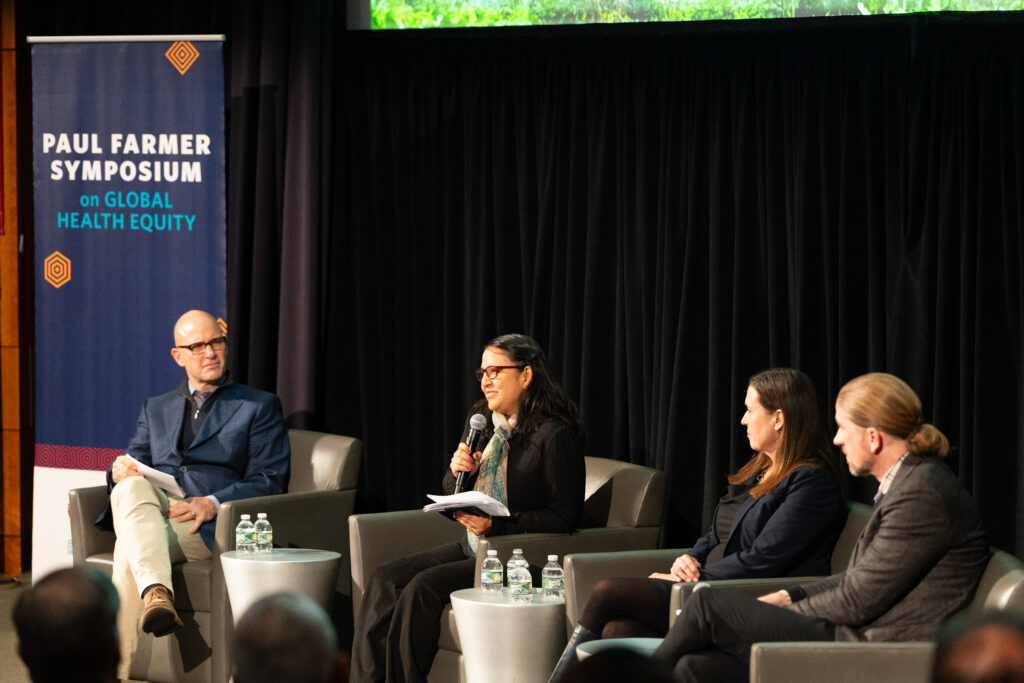
From left to right are moderator, Dr. Giuseppe (Bepi) Raviola, followed by panelists Dr. Carmen Contreras, Dr. Theresa Betancourt, and Dr. John Naslund speaking on the first panel at the Paul Farmer Symposium on Global Health Equity.
According to the World Health Organization, more than one billion people worldwide live with a mental health condition, yet most do not receive adequate care. Persistent barriers such as underfunding, workforce shortages, stigma, and fragmented health systems continue to widen the global mental health treatment gap, underscoring the urgent need for scalable, equitable solutions.
At the Paul Farmer Symposium, held in November 2025 at the Harvard Medical School and organized by the non-profit co-founded by the late HMS professor Paul Farmer, Partners In Health, global health leaders convened to examine how innovation, research, and community-led models can advance mental health equity worldwide. This year’s symposium centered on the theme “Mental Health Matters,” highlighting mental health as a foundational component of global health systems.
Across the day, the symposium explored global mental health through two panels and a keynote, spanning care delivery and research, U.S. advocacy and policy, and the enduring legacy of accompaniment. One panel focused on impact in global mental health care delivery and research, exploring how task-sharing, digital tools, and community-driven implementation strategies are transforming access to care in diverse settings. Building on perspectives from research, frontline program implementation, and policy-oriented work, the panelists emphasized that meaningful impact occurs when prevention, treatment, and support are integrated with dignity, equity, and sustained community engagement.
Among the panelists were former HGHI Burke Global Health Fellow John Naslund, PhD, and former HGHI LEAD Fellow Carmen Contreras, MSc, along with Theresa S. Betancourt, ScD, MA. Together, they emphasized how collaboration across research, policy, and practice can translate innovative approaches into lasting, systems-level change.
Addressing Gaps in Mental Health Care
“To really make an impact, we need to look outside the health system. Faith-based groups, veteran-serving organizations, and rural community groups are adopting these programs, and that’s where change can take root,” said Dr. Naslund as he stressed the importance of reaching beyond traditional health systems.
Contreras highlighted community health workers as central to expanding access and how they are the heart of the program in Peru.
“They visit every mother at home, every week for 16 weeks. Supporting their motivation and providing continuous learning has been key to reaching over seven hundred mothers with depression,” she said.
Innovation in Response to Crisis
Crises such as the COVID‑19 pandemic accelerated the adoption of digital and task-‑sharing innovations to expand mental health care. In her work at Socios en Salud in Peru, Carmen Contreras described how the team rapidly deployed digital tools, including ChatBot‑Juntos and EVA, specialized chatbots to screen for distress and support adolescents living with HIV, reaching tens of thousands of people with remote psychological support. These innovations were piloted during the pandemic and are now part of scalable mental health programs deployed across multiple regions of Peru.
Similarly, John Naslund’s research at the Mental Health for All Labexplores how digital technology can enable task sharing in community settings. Projects like SAMARTH in India use digital tools (e.g., the mindLAMP app) alongside community-delivered care to integrate schizophrenia treatment into primary care. His work also documents how digital platforms can be used to train, support, and supervise nonspecialist providers to expand workforce capacity where specialists are scarce.
Strategies for Scale and Impact
In global health, sustainable impact depends on strengthening systems around community-based care. Key strategies proposed by the panelists included:
Community Engagement: Addressing stigma, understanding local needs, and involving individuals with lived experience in program design.
Supportive Systems: Multi-layered supervision, referral pathways, and continuous learning cycles to maintain quality and fidelity.
Workforce Support: Providing social and psychological support to community health workers to prevent burnout and sustain motivation.
System Integration: Aligning interventions with governance structures, referral networks, and feedback loops to support scale and adaptation.
Policy Advocacy: Building evidence and demonstrating return on investment to elevate mental health within national health equity agendas.
Reinforcing mental health service delivery requires investments in core inputs for health system performance. These approaches are described by the 5 S’s, a model Paul Farmer often taught: Stuff, Space, Systems, and Social Support.
Looking Forward
The panel concluded that the next frontier in global mental health lies in scaling evidence-based interventions without compromising quality or equity. Lessons from Peru, Rwanda, India, and high-income settings such as the United States demonstrate that community-centered, evidence-based care is both feasible and essential for closing the global treatment gap. Speakers came to a shared conclusion that building resilient mental health systems depends on collective action across disciplines, sectors, and geographies.
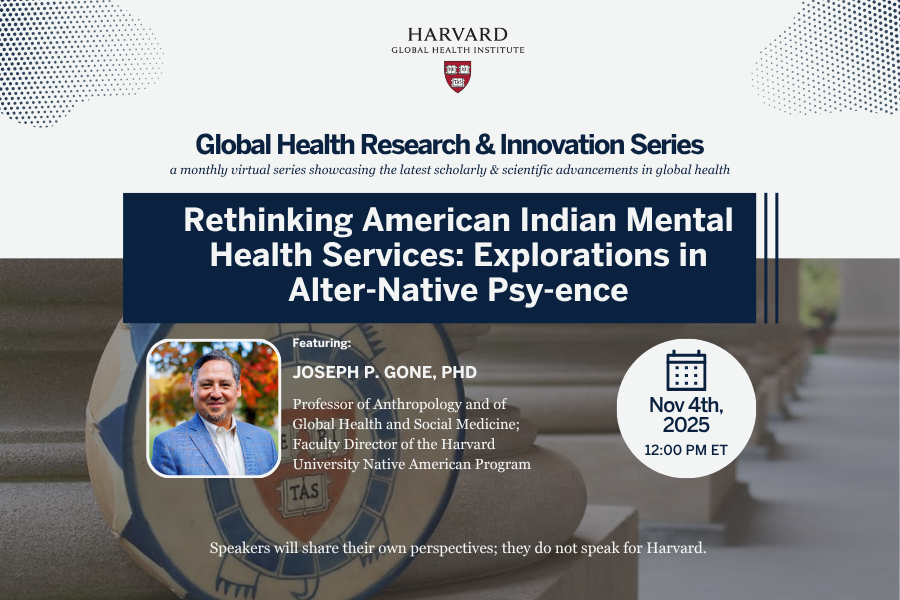
In this talk, Professor Joseph P. Gone explores how Indigenous perspectives can reshape understandings of mental health, challenging Western psychiatric frameworks and reframing “mental health” concerns as postcolonial disorders.
Today (October 10th) is World Mental Health Day 2025. At Harvard, students are engaged in various projects to raise mental health awareness throughout the year. One such example is HGHI student summer intern, Anna Zettelmeyer ’26, whose work in India reflects the spirit of the day by advancing mental health equity, global collaboration, and community-based care.
Professor Byron Good reflects on two decades of mental health work in post-conflict Aceh, revealing how international collaboration can shape long-term recovery and resilience. Featuring: