Climate, Environment, and Health, Global Health Security, Health Justice
health systems
Scholarly Working Groups
Enhancing the Resilience of Europe’s Civilian Health Systems as Conflict with Russia Escalates
Members of the Scholarly Working Group gather at the Harvard Global Health Institute to develop threat scenarios and stress-test protocols.
In response to escalating tensions between NATO and the Russian Federation, leading scholars and practitioners in global security, public health, economics, and health systems convened at the Harvard Global Health Institute (HGHI) on May 1–2, 2025 to examine strategies for enhancing the resilience of civilian health systems to disruptions resulting from armed conflict.
Organized by HGHI’s interdisciplinary Scholarly Working Group led by Margaret Bourdeaux, Assistant Professor at Harvard Medical School, the two-day workshop marked a critical step forward in understanding the mechanisms by which civilian health systems are disrupted by armed conflict, how vulnerabilities in health systems can be assessed, and how mitigations can be generated. Participants developed three detailed threat scenarios — cyber/hybrid warfare, invasions of NATO buffer states, and a nuclear strike — to serve as stress test models for evaluating the performance and resilience of national health systems under extreme strain. These scenarios were crafted to expose cross-sector weaknesses and threats to health systems, taking into account financial constraints, disease burdens, and population needs.
Framing the Challenge: Conflict between NATO nations and Russia
The convening commenced with presentations by leading experts on Russia-NATO relations, offering an assessment of potential ways Russia might escalate its confrontation with the West. Three key dimensions of escalation were examined: the use of kinetic force (i.e., physical military action involving weapons), the deployment of disinformation to promote Russian state narratives and sow discontent among the population toward Western leaders, and the use of cyber warfare, sabotage, or deniable low-scale attacks.
Brigadier General Kevin Ryan, former U.S. Defense Attaché, opened the session with an analysis of various scenarios in which Russia might seek to violate the territorial integrity of NATO member states and partner nations.
“Russia’s military thinking is ground-force centric,” he explained, “but its security rests on two pillars: conventional campaigns and nuclear deterrence.”
In addition to traditional military actions, Anita Parlow, a journalist and scholar at A.L. Parlow & Associates, LLC, suggested that hybrid warfare on Arctic communities bordering Russia and U.S. geopolitical posture were also deployed as a tactic.
Another non-traditional warfare tool is health misinformation campaigns, such as those during COVID-19, which are widely adopted to destabilize societies without direct confrontation.
“Effective disinformation campaigns don’t need to convince. Just confuse or polarize,” said Jon Roozenbeek, Assistant Professor in Psychology and Security at King’s College London. He explained that AI-generated propaganda, conspiracy messaging, and foreign-funded influence networks are now central tools of hybrid warfare.
“This isn’t ideological warfare., iIt’s strategic destabilization,” Roozenbeek added. “Long-term exposure is the weapon, not persuasion.”
Experts at the workshop agreed that the health consequences of modern conflicts extend far beyond battlefield casualties. It requires preparedness frameworks that account for simultaneous military, informational, and financial attacks on medical systems to address the issue.
Professor Matthew Andrews, Edward S. Mason Senior Lecturer in International Development at Harvard’s Kennedy School of Government said that systemic breakdowns in financial infrastructure–banking, contracts, and fund transfers–is one of the key health system stressors during wartime. Governments need to understand not just the availability of funds, but also the functionality of systems. Priority needs to be given to stabilizing the healthcare system and its workforce, as well as employment and tax systems.
What Risks Could Disrupt Health Systems?
Based on their potential to disrupt health systems over different lengths of time and governments’ ability to coordinate across sectors and borders, three threat scenarios were selected to further develop as health system “stress tests”. Participants emphasized the need for stress tests to include short and long-term health system performance metrics, not just immediate crisis response indicators.
Health System Vulnerability Assessment Tool
Civilian health systems vary considerably across states in their scope, governance, and structure, making it challenging to predict how different health systems will perform in different threat scenarios. To address this challenge, the second day of the convening focused on developing a health system core operational processes assessment tool that health system leaders can use to identify and describe how their specific health systems operate at baseline and during periods of crisis. Acting as hypothetical health ministers, participants considered questions of financing, governance, information systems, and workforce retention, when developing this survey tool.
Next Steps: Ongoing Collaboration
The working group will refine scenarios and finalize the comparative system analysis survey tool, with a focus on developing and trialing health system stress test protocols in the coming months.
Insights from this convening will feed into ongoing dialogues with NATO, EU partners, and humanitarian actors, contributing to strategic planning efforts aimed at protecting civilian health systems under threat. As the geopolitical landscape continues to evolve, so too must our collective ability to anticipate, plan, and respond.
HGHI Scholarly Working Groups
The Harvard Global Health Institute’s Scholarly Working Groups are designed to encourage a collaborative environment, promote inter-faculty gatherings, and explore and accelerate research areas in topics critical to the advancement of “Health for All”. Each Scholarly Working Group includes faculty from at least two schools across Harvard University. Through these working groups, we aim to catalyze ideas, inspire the writing of grants, policy briefs, or working papers, or build networks to advance a program of work.
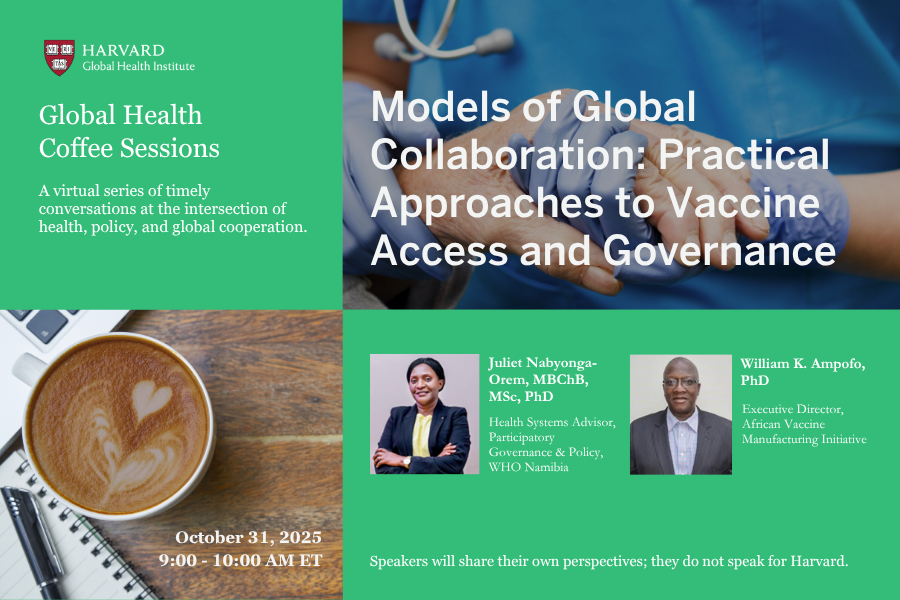
This panel explores how nations are advancing local vaccine manufacturing to accelerate health equity, offering insights into what national ownership looks like for vaccine development and distribution today, especially as traditional donor support declines.
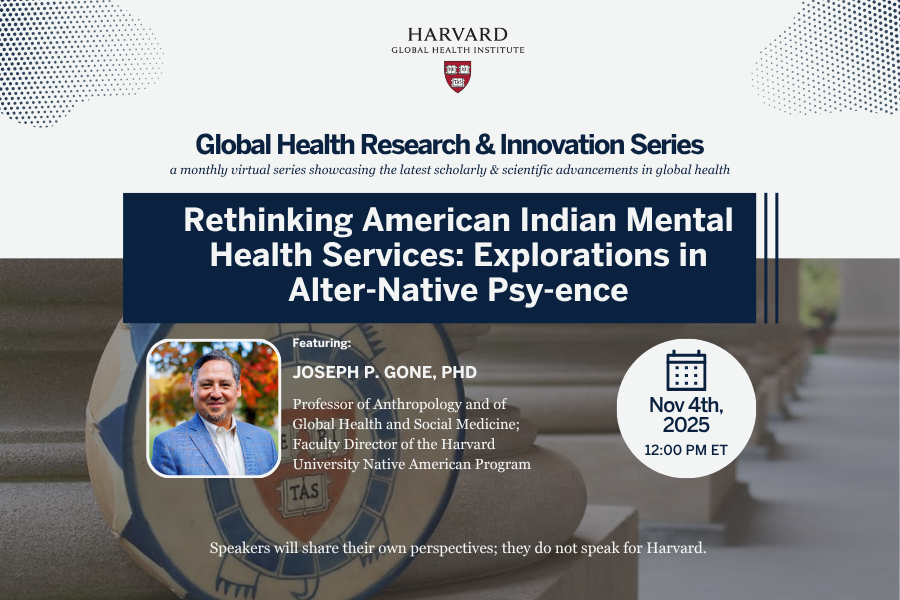
In this talk, Professor Joseph P. Gone explores how Indigenous perspectives can reshape understandings of mental health, challenging Western psychiatric frameworks and reframing “mental health” concerns as postcolonial disorders.
A new letter published in The Lancet, “Global donor funding for COVID-19 was largely disbursed as loans: it’s time to adjust,” co-authored by Jehane Sedky, Abbey Gardner, and Louise Ivers, examines how global COVID-19 aid was delivered—and what the data reveal about the state of international solidarity.