Q&A with Dr. Al Ozonoff: Strengthening Genomic Surveillance in West Africa
As part of the Harvard Global Health Institute’s Research and Innovation Speaker Series, Dr. Al Ozonoff joined us on June 10 to present “Sentinel: Strengthening Surveillance Capacity in West Africa for Preparedness and Response.” In this follow-up Q&A, Dr. Ozonoff responds to questions from attendees, offering deeper insight into the Sentinel program and its vision for sustainable, locally led public health systems.
How does the Sentinel program ensure the sustainability and long-term local ownership of surveillance capacity, particularly regarding ongoing training, equipment maintenance, and funding after the initial implementation phase?
One of the biggest barriers to genomic surveillance in low- and middle-income countries is the cost of sustaining systems once they’re built. Even when tools exist, many governments face budget constraints that make advanced diagnostics, sequencing, and data platforms hard to maintain. Sentinel, a collaborative initiative between the Broad Institute and the Institute of Genomics and Global Health in Nigeria, addresses this by designing tools that are open-access, low-cost, and built for integration into national health systems from the outset. Our data systems are provided at cost, and diagnostics platforms bring testing to under-resourced clinics for less than $1 per sample.
Another challenge is building and retaining a skilled local workforce. Many countries lack trained personnel in genomics, bioinformatics, and public health data systems. Sentinel tackles this through embedded university partnerships and modular training programs that are integrated into national institutions to ensure long-term capacity.
Political commitment is critical. Sentinel works closely with ministries of health and finance to embed genomic surveillance into national plans and budgets, and collaborates with regional institutions like Africa CDC to harmonize protocols and promote cross-border coordination. The goal is full country ownership, but some countries will need longer-term external support, particularly in conflict-affected regions or early-stage systems.
Global health institutions can help by investing in catalytic infrastructure, supporting local leadership, and aligning funding with national strategies. Just as important is the need for long-term, flexible support to sustain innovation, build trust, and ensure these systems are ready before the next crisis hits. The return on investment is clear: preventing even a fraction of a pandemic’s impact saves lives and avoids billions in economic losses.
What are the biggest barriers politically, financially, or logistically to scaling genomic surveillance systems in LMICs, and how can global health institutions help overcome them?
Scaling genomic surveillance in low- and middle-income countries faces major barriers. The biggest challenges are high costs, limited workforce capacity, and fragmented infrastructure. Even where technology exists, it is often too expensive for routine public health use. Sentinel tackles this by developing low-cost, open-access tools that can be deployed in low-resource settings and sustained by local health systems.
Workforce shortages are another obstacle. Many countries lack trained personnel in genomics and data science. Sentinel addresses this through modular training, university partnerships, and fellowships that build in-country leadership over time.
Logistical hurdles, like inconsistent lab infrastructure, supply chain issues, and unreliable power, are also significant. Sentinel is designed to work in these environments, using tools that function offline, cloud-based platforms that tolerate intermittent connectivity, and solar power to reduce disruptions.
Policy and regulatory inconsistencies can slow progress, especially when expanding across borders. Sentinel engages national governments early, aligns with WHO and Africa CDC frameworks, and co-develops protocols with ministries and local partners. These relationships help navigate political transitions and sustain programs beyond any one administration.
Finally, trust is critical. In many high-risk areas, surveillance depends on relationships with frontline workers and communities. Sentinel builds those relationships from the ground up, by working through local leaders, supporting health education, and ensuring systems are co-owned by the people they serve.
Global institutions can help by investing in long-term capacity, not just emergency response. That means funding not just tools but also training, infrastructure, and regional coordination. It also means backing country-led efforts and aligning with national strategies, so these systems can endure after external support ends.
Dr. Al Ozonoff is the Director of Pandemic Preparedness at the Broad Institute and Associate Professor at Harvard Medical School. He directs the Sentinel program, a partnership between the Broad Institute and the Institute of Genomics and Global Health in Nigeria. Learn more about this event.
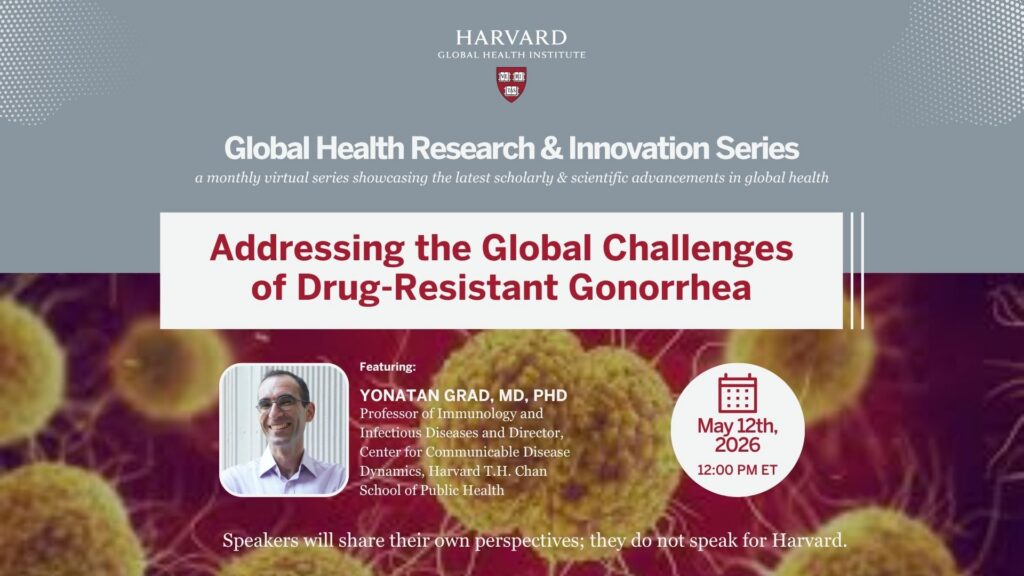
Yonatan Grad, Professor at Harvard T.H. Chan School of Public Health, discusses how drug-resistant gonorrhea highlights broader challenges in antimicrobial resistance.
In this talk, Professor Yonatan Grad presents recent advances in the diagnosis, treatment, and prevention of gonorrhea, and discusses emerging frameworks for optimizing implementation and rollout strategies in diverse healthcare settings.
A new letter published in The Lancet, “Global donor funding for COVID-19 was largely disbursed as loans: it’s time to adjust,” co-authored by Jehane Sedky, Abbey Gardner, and Louise Ivers, examines how global COVID-19 aid was delivered—and what the data reveal about the state of international solidarity.