April 16th, 2026
Global Health Forward: Strength Through Innovation and Collective Action

National, Regional and Global Health Governance: Latin American Perspectives

Panel Description

Hosted in partnership with the Petrie-Flom Center for Health Law, Policy, Biotechnology, and Bioethics, Harvard Law School and the David Rockefeller Center for Latin American Studies at Harvard University.

Latin America is an extremely diverse region, but there are some commonalities across countries in terms of socio-economic and other inequalities that deeply impact social determinants of health. Most countries have fragmented health systems that further aggravate inequities and present challenges for achieving Universal Health Coverage (UHC).  The COVID-19 pandemic brought many health systems to verge of collapse. The region faces a growing burden of chronic diseases, while governance is affected by regulatory deficits, the absence of systematic priority-setting, and high degrees of judicialization of health rights. Further, multiple countries in the region are moving toward more conservative governments aligned with the Trump administration, and these shifts may directly affect health financing and governance. This session addresses some of these themes as well as the role for PAHO at this critical juncture. 

Key Takeaways

  • Health inequities in Latin America are fundamentally structural and rooted in broader social and economic inequality. Deep disparities across income, geography, ethnicity, and gender shape unequal health outcomes across the region, and the COVID-19 pandemic intensified these gaps, particularly for rural and marginalized populations, while financial protection remains weak and out-of-pocket spending, especially on medicines, continues to drive catastrophic household costs.
  • Fragmentation is the defining structural constraint of Latin American health systems and a major barrier to universal health coverage. Most countries operate multiple parallel subsystems tied to employment, institutional affiliation, or income, resulting in segmented financing, service delivery, and entitlements, and even where insurance coverage is near-universal, as in Peru, access to care remains highly unequal and dependent on system design rather than population need.
  • Chronic underinvestment and fiscal constraints continue to undermine system performance, equity, and sustainability. Public health spending remains below regional targets, increasing reliance on household spending and reinforcing inequality, while informality and economic volatility weaken the long-term viability of social insurance models and limit the state’s capacity to provide consistent, high-quality services.
  • Health governance in the region is highly politicized, and reform trajectories are shaped by instability, polarization, and competing institutional pressures. Frequent leadership turnover, short political cycles, and ideological conflict weaken continuity and long-term planning, while judicialization has emerged in some countries as both a response to system failure and an alternative mechanism for enforcing health rights in the absence of effective priority-setting.
  • Future progress depends on strengthening governance capacity, coordination, and evidence-based decision-making under conditions of constraint. Regional institutions such as PAHO, alongside development partners like the IDB and World Bank, are increasingly focused on coordination, technical cooperation, and system integration, while long-term sustainability will depend on improving data quality, embedding ethical priority-setting, and ensuring that reforms explicitly address populations systematically left behind.
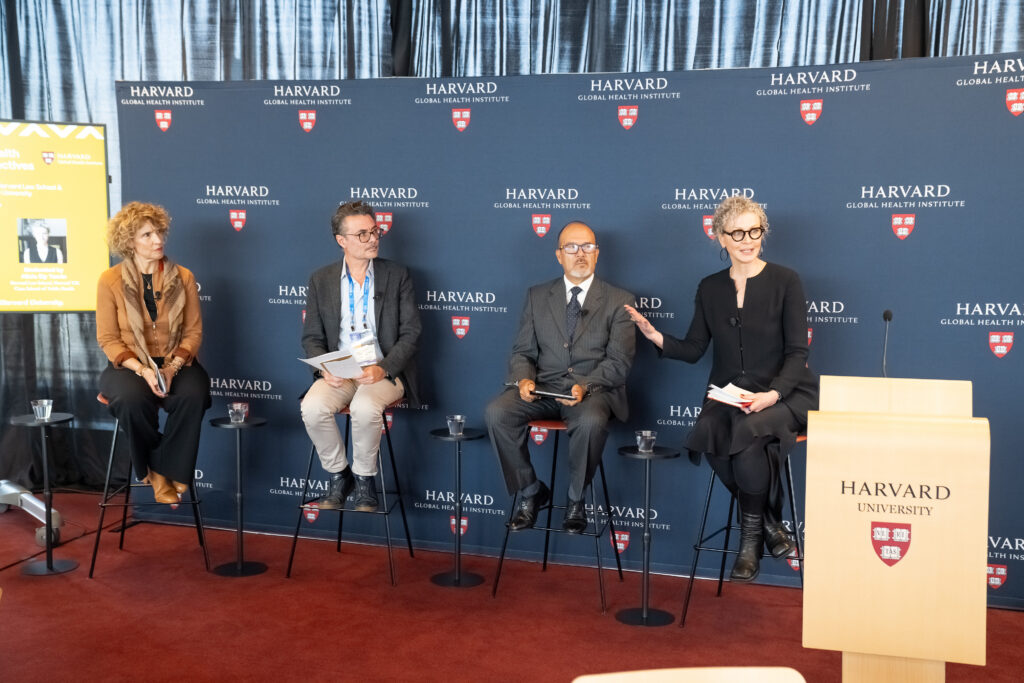
Speakers at the panel "National, Regional and Global Health Governance: Latin American Perspectives"

“Fragmentation is not just an efficiency aspect; it’s a human‑rights perspective and we have to look after that.”

Victor Zamora

Resources

Speakers

Alejandro Gaviria Headshot

Alejandro Gaviria, PhD

Former Minister of Health and Social Protection (2012-2018); Former Minister of National Education (2022-2023), Colombia

Alejandro Gaviria, PhD is a Colombian economist, writer, and politician. He holds a PhD in Economics from the University of California and has served as Colombia’s Minister of Health and Social Protection and as Minister of Education. He has worked aa researcher at the Inter-American Development Bank (IDB) and has held senior academic leadership positions at the University of the Andes, including Dean of the Faculty of Economics and President of the University. Dr. Gaviria has published dozens of academic articles on social policy and development and haauthored more than ten books that blend literary essay with a critical perspective on contemporary politics.

Claudia Pescetto Headshot

Claudia Pescetto, MA

Regional Advisor, Evidence and Information for Health Economics and Financing, PAHO/WHO

Claudia Pescetto is a Chilean economist, graduated from the Pontifical Catholic University of Peru and holds a Master of Arts in Applied Economics from Johns Hopkins University. She currently serves as the Regional Advisor for Evidence and Information in Health Economics and Financing at the PAHO/WHO office in Washington, DC. She has more than 20 years of international experience providing policy advice on health financing reforms and helping countries develop capacities related to these topics. She is the author and co-author of several publications on public policy in health financing; measurement and analysis of health and primary care expenditure; strategic purchasing and design of payment mechanisms in integrated health service networks; fiscal and budget space in health; public financial management and effective budget execution in health; among others. Before joining PAHO/WHO, Claudia worked at the International Monetary Fund (IMF) as a research analyst in the Monetary and Capital Markets Department. During her professional career in Peru, she worked for the Macro group as a macroeconomist and later as an analyst of stock market and financial assets.

Victor Zamora Headshot

Victor Zamora, MD, MA

Former Minister of Health, Peru; Professor of Health Policy at the School of Government and Public Policy, Pontifical Catholic University of Peru; Executive Director, Gobierna Consultores SAC

Victor Zamora is a distinguished physician and health policy expert with nearly 40 years of experience in health systems across Latin America and the Caribbean. He served as Peru’s Minister of Health (2020–2021), leading the national response to the COVID-19 pandemic. Dr. Zamora has an extensive background in international cooperation, including roles as an International Advisor for PAHO/WHO and DFID-UK, and Assistant Representative for UNFPA. He holds a Master’s degree in Health Management, Planning, and Policy from the University of Leeds (UK) and postgraduate studies in Health Economics from Pompeu Fabra University (Spain). Currently, he is the Executive Director of Gobierna Consultores SAC and a Professor of Government and Health Policy at the Pontifical Catholic University of Peru. He is also a published author on health governance, resilience, and equity. 

Alicia Yamin Headshot

Alicia Ely Yamin, JD, MPH, PhD

Lecturer on Law and the Senior Fellow on Global Health and Rights, Petrie-Flom Center, Harvard Law School; Adjunct Senior Lecturer on Health Policy and Management, Harvard T.H. Chan School of Public Health

Alicia Ely Yamin, JD, MPH, PhD is a Lecturer on Laand the Director of the Global Health and Rights Project at the Petrie-Flom Center for Health Law Policy, Biotechnology and Bioethics at Harvard Law School; Adjunct Senior Lecturer on Health Policy and Management at the Harvard TH Chan School of Public Health; and Senior Adviser on Human Rights and Health Policy at Partners In Health. Known globally for her trans-disciplinary work in relation to economic and social rights, reproductive justice, the right to health, and the intersections between development paradigms and human rights, Dr. Yamin’s career has bridged academia and activism. She has lived in Latin America and East Africa for much of her professional life and worked with locaadvocacy organizations, including co-founding a program on health and human rights in the Asociación Pro Derechos Humanos (Lima, Peru; 1999). Dr. Yamin has served on numerous WHO and UN expert committees and regularly provides testimony and guidance to tribunals and legislative bodies around the globe in relation to the application of internationaand comparative law to health and sexuaand reproductive rights issues.