When AI Meets Global Health: Who Governs, Who Benefits, and What Works?
As artificial intelligence (AI) becomes increasingly embedded in health systems worldwide, questions about how these technologies should be governed, evaluated, and implemented have become as consequential as the technologies themselves. Across a four-part virtual discussion series convened by the Harvard Global Health Institute (HGHI) in partnership with the Center for Bioethics at Harvard Medical School this spring, experts from academia, multilateral organizations, government, philanthropy, and civil society examined the opportunities, challenges, and key questions shaping AI’s role in global health. Together, the discussions revealed that AI’s impact will not be determined by technological capability alone, but by the interconnected systems of governance, research, and implementation that shape how these tools are developed, deployed, and sustained.
“We must break the cycle of a lack of accountability and find the right balance between the speed of AI adoption and the rigor needed to ensure these technologies are safe, effective, and responsive to the communities they are intended to serve,” said Louise Ivers, HGHI Faculty Director. Through these focused discussions on governance, partnerships, evaluation, and implementation, speakers examined what this balance requires in practice.
When Governance Trails Technological Change
AI governance is being actively negotiated through national strategies, institutional guidelines, and global frameworks, reflecting the imperative for questions of accountability to evolve alongside technological development. Yet, as the discussions in this series highlighted, governance often remains reactive, attempting to establish boundaries for AI systems already being deployed rather than shaping how they are developed from the outset. The central challenge is not only defining responsible AI principles, but ensuring they translate into locally relevant approaches, strengthen countries’ capacity to govern emerging technologies, and advance equity rather than deepen existing divides.
The UNESCO Recommendation on the Ethics of Artificial Intelligence, adopted in 2021, calls for AI systems to be developed and used in ways grounded in human rights, transparency, fairness, and human oversight. But translating principles into practice requires more than shared values; it requires the institutional capacity and local expertise to shape how AI is developed and applied.
Gabriela Ramos, Assistant Director-General for the Social and Human Sciences Sector at UNESCO, emphasized that this means ensuring countries are not simply recipients of AI technologies, but active participants in shaping them.
“One of the things that I feel is important is getting the conversation back to the realities of the Global South, to the very specific needs of each single country, and then defining what kind of capacities they want to bring up to better understand the technologies and to shape them.”
Power, Partnerships, and the Politics of Deployment
Governments, philanthropies, academic institutions, technology companies, and local actors are increasingly collaborating to deploy AI in health. Yet, as discussions throughout the series highlighted, these partnerships are far from neutral exchanges of technology; rather, they are shaped by questions of power, ownership, and decision-making. Model development remains concentrated in a small number of high-income countries, while many deployment settings risk being positioned not as co-creators, but primarily as markets for consumption and testing.
These dynamics raise fundamental questions about who defines problems, whose expertise informs design decisions, and who has influence over how AI systems are deployed, evaluated, and governed. Without deliberate attention to these power structures, AI risks reinforcing existing inequities under the guise of technological neutrality.
Emerging approaches from the Global South offer alternative models of engagement. Esther Kunda, Director General of Innovation & Emerging Technologies at Rwanda’s Ministry of Information Communication Technology (ICT) and Innovation, discussed Rwanda’s approach to AI governance and partnerships, including efforts to align emerging technologies with national priorities through the country’s National AI Policy. Rwanda’s experience highlights a broader shift away from viewing countries primarily as adopters of externally developed technologies and toward strengthening local capacity and agency to shape how AI is developed and deployed on their own terms.
Chinasa T. Okolo, Founder and Scientific Director of Technecultura and an AI governance researcher, argued that optimism about AI must be grounded in realism. Local ecosystems across the Global South must be strengthened rather than made dependent on external technology providers, and investment in AI should not come at the expense of hospitals, supply chains, and health workforces—the foundations of resilient health systems.
Evidence, Evaluation, and the Problem of Fit
Another challenge emerging from these discussions is how impact should be measured as AI systems rapidly evolve. Traditional evaluation frameworks in global health were largely developed for interventions with defined inputs, outputs, and timelines. AI systems, by contrast, are iterative and adaptive, creating a mismatch between the speed of deployment and the pace of validation. Metrics such as accuracy and efficiency capture only part of the picture, often failing to show whether technologies address community priorities, strengthen health systems, or improve equitable health outcomes in practice.
Addressing this gap requires evaluation frameworks that move beyond technical performance alone to incorporate local contextual factors, community priorities, and system-level outcomes. Efforts supported by organizations such as the International Development Research Centre (IDRC) have highlighted the importance of building evaluation capacity in the Global South and developing approaches that allow researchers and communities to assess whether AI tools are addressing the problems they were intended to solve.
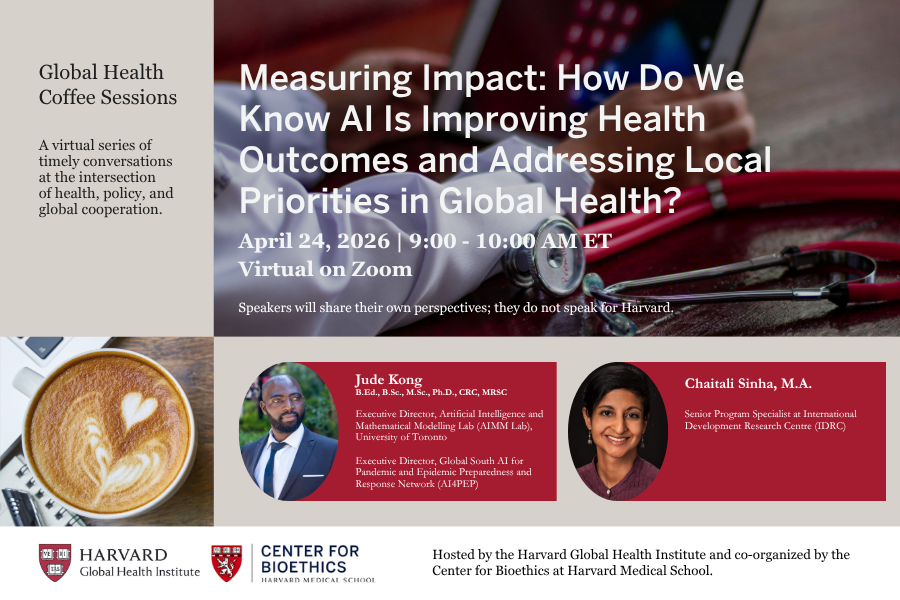
For instance, Jude Kong, professor in the Dalla Lana School of Public Health at the University of Toronto and director of the Global South Artificial Intelligence for Pandemic and Epidemic Preparedness and Response Network (AI4PEP), pushed back against the notion top-down evaluation models. For him, accountability is not a final audit but a continuous practice:
“If you build a solution with the community, the community needs to evaluate themselves to see whether their problem is being met. At the same time, the funders can evaluate themselves. When you say your objective, you evaluate as you go, rather than wait till the end.”
Implementation and the Limits of Technical Design
Even where governance, partnerships, and evidence frameworks are evolving, implementation remains the point at which AI systems succeed or fail in practice. Across contexts, effectiveness depends not only on model sophistication, but on the fit between technology and health system realities. A tool that performs well in a controlled environment may not translate into meaningful impact if it is not designed for the conditions in which it will ultimately be used.
Sameer Pujari, AI Lead for Global Digital Health Strategy & Governance at the World Health Organization, summarized this challenge:
“It must be a systemic approach, and it must be localized. There is no one formula-fit-all approach for healthcare systems, because there are very different requirements for different countries.”
That localization must be centered around the experience and expertise of health workers who will ultimately use these tools and requires recognizing that implementation is a socio-technical process, not a purely technical one. Without that alignment, even technically robust systems risk both limited adoption and unintended consequences.
Toward Accountable and Equitable AI Systems
Collectively, the discussions pointed toward a common objective: the future of AI in global health depends less on technological capability alone than on the systems built around it. Rather than searching for a single governance framework or technical solution, speakers emphasized the need to strengthen the institutions, partnerships, and evaluation approaches that determine how AI is developed, deployed, and sustained. As AI continues to evolve, these conversations will remain essential to ensuring innovation translates into equitable and meaningful improvements in health.
Explore the AI in Global Health Coffee Session Series
This discussion examines AI’s potential to strengthen global health systems while exploring the evidence, infrastructure, and capacity needed to translate innovation into impact.
Explore key insights on how governments and funders can foster equitable, locally driven partnerships to responsibly scale AI innovation in global health.
Explore key insights on how governments and funders can foster equitable, locally driven partnerships to responsibly scale AI innovation in global health.