Finding Problems Worth Solving: A Design Thinking Approach in Global Health
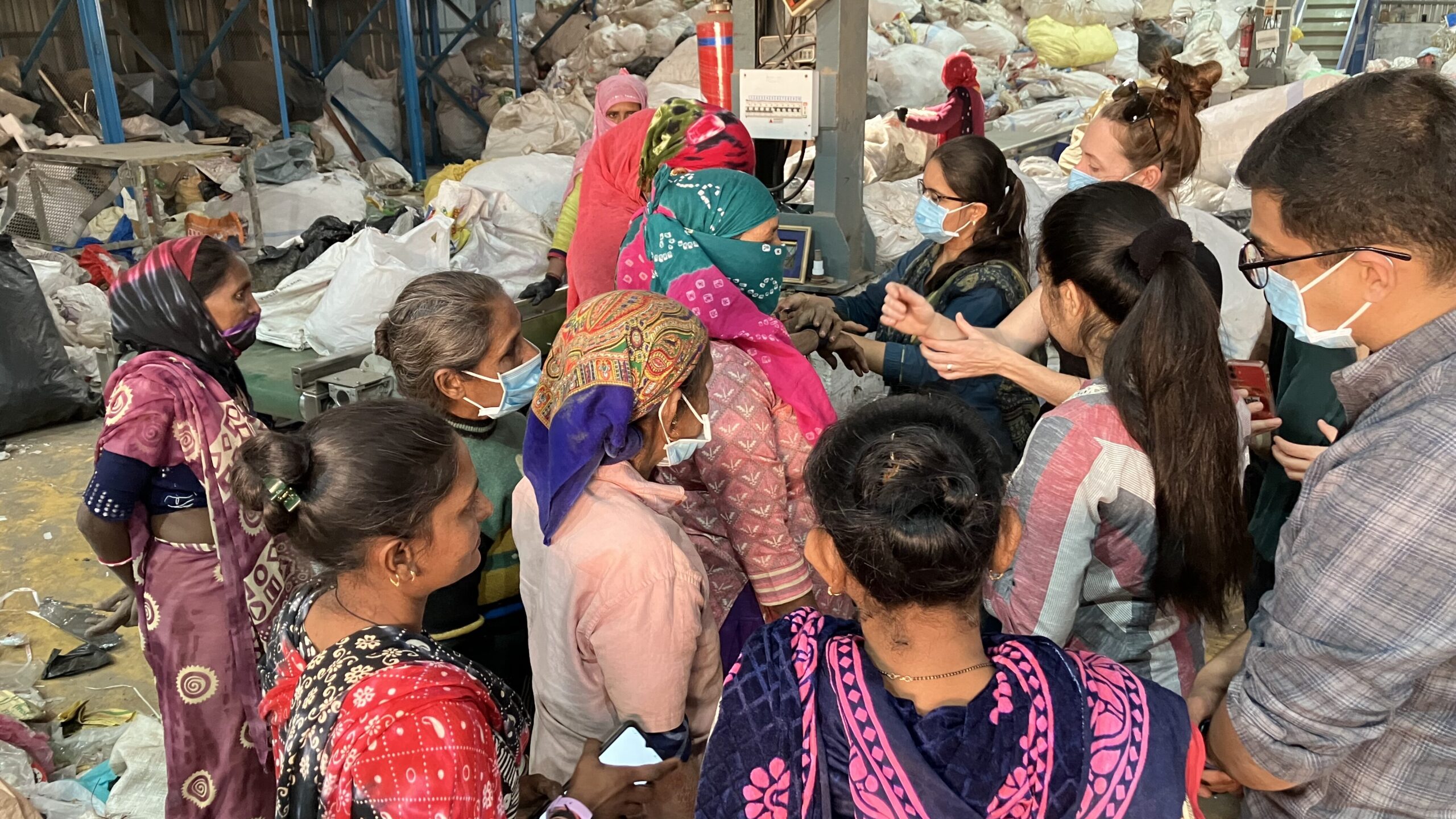
The Harvard research team tours a waste recycling facility in Ahmedabad, India, to study the thermal comfort challenges faced by women workers. (Jan–Feb 2024 | Credit: BalsariLab)
Across much of global health research, communities are frequently studied without being meaningfully involved. Instead, people are surveyed, measured, and written about from a distance. However, Satchit Balsari, Associate Professor in Emergency at Harvard Medical School and Harvard T.H. Chan School of Public Health, and a Faculty Steering Committee member at the Harvard Global Health Institute, has built a career challenging that default.
Over the last two decades, his lab has followed disasters and humanitarian crises across the globe, including natural disasters, like earthquakes, floods and hurricanes in South Asia, the U.S., and Central and South America, as well as populations displaced by wars and refugee crises in Bangladesh and the Middle East. Throughout, he has been drawn to the application of new and emerging technologies to advance health and human rights in populations in distress.
That trajectory has led him to a distinctive way of solving problems in global health—one that looks a lot like design thinking in practice. Instead of starting with a dataset or a shiny new tool, Balsari starts with the people most affected, asks what they see as the greatest gaps, and then “reverse engineers” the research and technology to serve those needs.
From Data to Decisions in Disasters
A central pillar of Balsari’s recent work is CrisisReady, which he works alongside two long-time collaborators, Harvard professor Caroline Buckee and vice president of Direct Relief, Andrew Schroeder. Together, they ask a basic question: how do you take cutting-edge research and convert it into tools that are valuable to communities?
Their answer is to start not with technology, but with conversations.
“CrisisReady works in very close collaborations with communities around the world, where we ensure that we understand what the missing information gaps are, and then we find the data streams that will help answer those questions,” explained Balsari.
The team is intentional about ensuring that dashboards are not used in a vacuum but shared directly with specific individuals and response agencies who can act on them. Using this model, the group has responded to over 50 disasters around the world in the last couple of years.
One powerful example comes from the recent wildfires in California. Balsari noted that the challenge in planning any rescue efforts is when people are evacuating from wildfires, but no one knows which direction they are going. The CrisisReady team was able to work with state officials in California and help them quickly determine, based on real-time mobility data, the best locations for rescue shelters and health operations.
For Balsari, this is design thinking in action: by deeply understanding a problem, testing ideas, and iterating with multiple perspectives in mind.
Climate, Heat, and the Hidden Costs to Workers
As climate change reshapes the landscape of disasters, Balsari’s work has increasingly focused on workers in extreme heat conditions. At the Harvard Global Health Institute, Balsari’s Scholarly Working Group is building on lessons learned from research that started at the Salata Institute, studying the impact of heat on workers. One of the central concerns is that much of the global response to heat risk is too narrow.
“Often when we talk about the impact of heat on workers, we measure mortality,” he said. “But leading up to mortality are often years, if not decades, of suffering and impact on morbidity and wages. How do you help communities and policymakers think through this?”
The challenge is especially stark in the informal economy.
“Our imagination is still wrapped up in guaranteeing workers shade, cooling, hydration breaks, and sanitation facilities,” he said. “We need to be so much more expansive than that. How do our economies have to be reengineered around the changing climate?”
The working group is trying to rigorously examine the evidence of these proposed protections and learn from best practices around the world, with particular attention to informal workers who lack the protection of a formal employer.
Technology as a Tool, Not a Driver
Balsari has been an early adopter of digital tools in global health, guided by a simple rule: tools follow gaps, not the other way around. His approach focuses on surveying the gaps that exist and then determining where digital solutions could effectively intervene.
His first major technological intervention came at the Kumbh Mela in India in 2013, which he calls “the world’s largest mass gathering then, attended by 80–100 million people over 55 days.” Harvard’s Mittal Institute had sent a huge interdisciplinary team there, and Balsari’s group focused on public health in 13 temporary clinics serving pilgrims.
“There was high risk of an epidemic outbreak. And they only had paper records,” he recalled. At that point, iPads and mobile hotspots had just hit the market. The team recruited medical students to sit next to the physician as each patient was seen. The clinician would scribble the chief complaint and the diagnosis down, and the students would digitize it. At the end of each day, they would go to the hotspot and put their data in.
“Without setting out to build one, we ended up with one of the world’s first near real-time syndromic surveillance systems, running for 55 days,” Balsari said. “Two years later, we were able to institutionalize this by getting rid of paper records and digitizing them at the following Kumbh in Nashik in 2015.”
The key point for him is that the technology followed the problem. “We didn’t start that project saying, ‘Hey, we have iPads: where should we apply these?’ It was very much like, ‘Oh, the data are here, and the problem they have is that they don’t have access to their own data because it’s across logbooks, spread across many kilometers. Is there a way to digitize that?’”
Too often, success is measured by adoption and enrollment rather than outcomes, with little evidence of real-world benefit. He worries that AI is now being applied just as other digital tools were – solutions looking for a problem. “I think we are developing AI solutions to solve problems that neither clinicians nor patients prioritized. Without doing the hard job of rigorous need finding, it is unlikely that these millions diverted away from other healthcare priorities will result in meaningful improvement in clinical and public health outcomes,” he said.
In his view, AI will not fix the core problems of global health unless structural issues are confronted. “Underfunded healthcare programs, unreliable inventories, understaffing and lack of accountability cannot all be wished away with a chatbot,” he notes.
Communities as Partners
Balsari’s orientation toward communities was shaped early in his career. Much of his initial work with Jennifer Leaning at the FXB Center involved rapid, field-based needs assessments in humanitarian crises around the world. The philosophy that undergirded their research and advocacy was that of bearing witness. Leaning, Balsari and their teams would travel to communities in distress and conduct research with them, to inform policy and response that communities most prioritized – whether the issue of orphaned and Restavek children in Haiti, or the access to work and livelihoods for Syrian refugees in Jordan or Rohingya refugees in Bangladesh, or emergency response training in South Sudan and Iraq. This kind of walking with the communities, or “accompaniment” was something the late Paul Farmer has extensively written about, notes Balsari.
Civil society organizations in India were another formative influence. Working with women’s empowerment groups like Kudumbashree Mission and trade unions like the Self-Employed Women’s Association (SEWA), Balsari very quickly learned that researchers did not need to speak for or about communities. “We need to learn to speak with the communities. They very often know what the problem is and what the solutions are,” he said. “You’re just offering the technical capacity to get there.”
Interdisciplinary by Design
The same design-thinking ethos shows up in Balsari’s teaching. For nearly 10 years, he co-taught a university-wide course called “Entrepreneurial Solutions to Intractable Social Problems” with colleagues from across disciplines: a business school professor, a romance languages professor, an architect, and an engineer/designer.
These experiences, he said, changed how he thinks about public health. “The education influenced the research, and the research influenced the education,” he reflected. “A lot of my thinking around these science problems was influenced by professors from other disciplines. How I thought about public health problems changed through teaching with those folks.”
In a field that often prizes models, metrics, and methods, his work offers a different starting point: humility, listening, and partnership.
What Can Each of Us Do?
For students, faculty, staff, and members of the public who care about climate, health, and equity, Balsari’s work suggests some concrete ways to act:
1. Begin with listening, not solutions.
Before proposing a research question, intervention, or startup, spend time with those most affected. Ask, as Balsari does, what communities “perceive as the greatest gaps,” and resist the urge to arrive with a polished answer.
2. Challenge tool-first thinking.
When you feel pulled toward the latest app, device, or AI model, pause and ask: What is the specific problem? Who defined it? Would this community choose this as their priority? Let the problem, not the tool, lead.
3. Treat community engagement as core expertise.
If you are a student or trainee, seek courses, internships, and projects that involve real engagement with local or global communities. “Roxbury has issues to sort out,” as Balsari noted, just as much as distant places. If you are faculty or staff, recognize this work as intellectually rigorous, not “extra.”
4. Keep workers, and especially informal workers, in view.
When thinking about climate and health, ask who is exposed to heat today: street vendors, delivery workers, construction laborers, and others in the informal sector. Electric cars and geothermal homes will do little for them. Support policies, research, and organizing efforts that prioritize their health, safety, and long-term livelihoods.
5. Cultivate interdisciplinary habits.
Take a class or join a project outside your home discipline. Work with designers, planners, data scientists, organizers, and humanists. As Balsari’s teaching and research experience shows, how you think about public health problems can fundamentally change when you work across fields.
By flipping the problem-solving model and anchoring it in community priorities, interdisciplinary collaboration, and a healthy skepticism of tool-first approaches, Satchit Balsari offers a compelling blueprint for how universities and the broader public can respond to the intertwined crises of climate, health, and inequality.
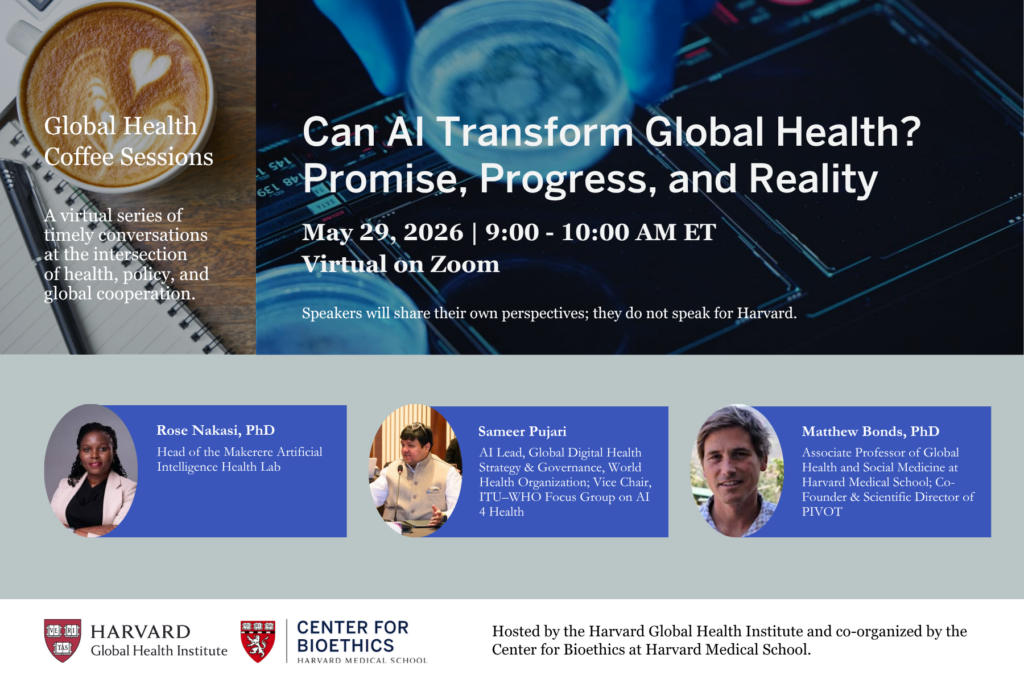
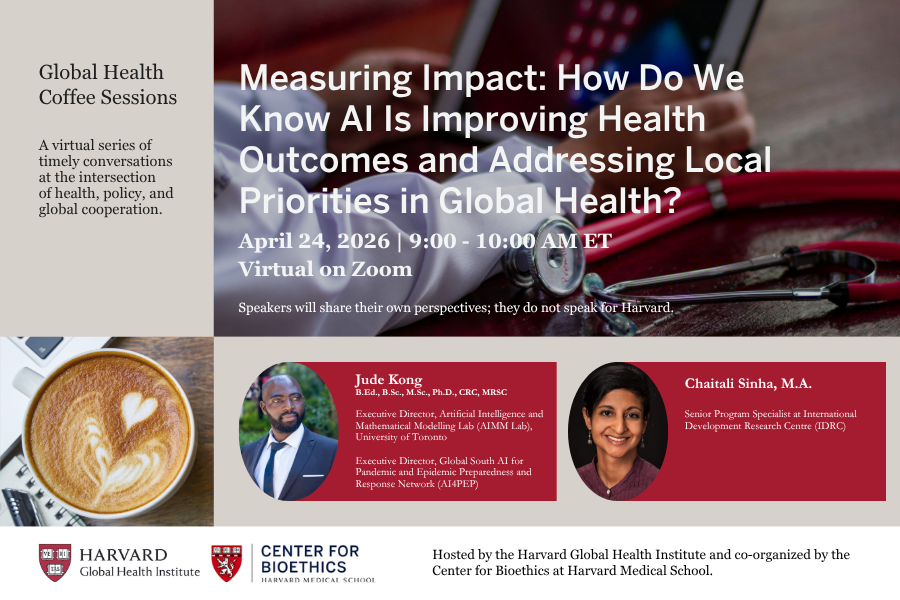
Across a four-part virtual discussion series this spring, experts from academia, multilateral organizations, government, philanthropy, and civil society examined the opportunities, challenges, and key questions shaping AI’s role in global health.
This discussion examines AI’s potential to strengthen global health systems while exploring the evidence, infrastructure, and capacity needed to translate innovation into impact.
Explore key insights on how governments and funders can foster equitable, locally driven partnerships to responsibly scale AI innovation in global health.